
Category: Uncategorized

  • Ad to Landing Page Message Match: Keep the Promise

    Ad to Landing Page Message Match: Keep the Promise

    Ad to landing page message match means the page delivers the exact promise the ad made: the same offer, the same audience, the same next step. Repeating the ad's headline words does not do that on its own. A visitor who clicks "free 14-day trial" and lands on a page selling a demo has met a broken promise, however similar the fonts. Match the promise first and the wording second. If the ad is the one overpromising, fix the ad.

    TL;DR:

    • Message match is continuity of promise (offer, audience, outcome, terms, next step), and copied headline text alone does not supply it.
    • The click is where attention is most fragile. Nielsen Norman Group research shows many visitors decide within roughly 10 seconds, and Google counts landing page experience in Quality Score.
    • The classic failure is matching the words while breaking the promise, usually at the button, the form or the price.
    • Build one page for each promise, and group keywords under it. If the ad overpromises, rewrite the ad instead of bending the page to match.
    • This week: screenshot every live ad beside its page, run a five-second test, and fix the single biggest break first.

    Table of Contents

    This is day 10 of the 100-day series, and principle 10 of the 100 field principles: "Keep the ad and landing-page promise continuous." Most advice on the topic stops at "repeat the headline," and that reading gets people into trouble.

    Ad to Landing Page Message Match: Match the Promise First

    An ad makes a promise, and a click is the reader accepting it. The landing page has one job: pay it off in the first screen, without making the reader re-decide.

    A promise has parts. Check each one:

    • The offer. Free guide, 14-day trial, 20% off, a quote. If the ad says one and the page leads with another, the match is broken.
    • The audience. "For freelancers" on the ad and "for modern teams" on the page tells the visitor they may be in the wrong place.
    • The outcome. What the reader gets, in their terms. Sell the outcome, not the product applies on both sides of the click.
    • The terms. Price, duration, conditions, what happens after the trial.
    • The next step. The action the ad implied, which the page's button and form should name.

    Repeating the headline satisfies none of these on its own. Plenty of pages repeat the ad's words and still break all five.

    Why Continuity Holds: Attention Is Cheapest Right Before the Click

    A hand holding a brass key about to enter a door lock, with the door slightly open onto a welcoming interior.

    A click is the most expensive moment in the funnel, because you have just paid for it. It is also the most fragile. Nielsen Norman Group's research on how long users stay on web pages found that the first 10 seconds are critical, since many visitors leave within that window. If those seconds go to working out whether this is the page they meant to visit, you have spent them on confusion.

    The platforms price this in. Google's documentation on Quality Score lists landing page experience as one of its components, so a page that fails to follow through on the ad costs you in auction terms as well as conversion terms.

    Landing page experience is one of three components of Google's Quality Score, alongside expected click-through rate and ad relevance.

    The principle is older than the web. The mail-order masters ran one continuous sale across the ad, the reply card and the order form. Claude Hopkins's Scientific Advertising (1923) treats advertising as measurable salesmanship, and in the spirit of that tradition, a reply coupon promising one thing while the order form sold another would have been caught the first time someone counted the returns.

    What To Carry Across the Click: Six Elements Compared

    Six small, varied objects arranged in a neat row on a wooden table.

    Use this table as an audit. For each ad, read across the row and ask whether the page keeps what the ad said.

    Element What the ad says What the page must do Typical break
    Offer "Free 14-day trial" Lead with the trial, not a demo Page pushes "Book a demo"
    Audience "For freelancers" Name the same reader above the fold Generic "teams of all sizes" copy
    Outcome "Get paid faster" Show that outcome, with proof Page lists features instead
    Terms "From $9/month" Show the price at the same level Price hidden behind a form
    Proof A specific number or claim Back that claim on the page Ad claim never appears again
    Next step "Start free" Button says the same thing Button reads "Submit" or "Contact sales"

    The table has no headline row because the headline only carries the promise. A good headline attracts the right customers and repels the rest, but it keeps the promise only if the six elements above come with it.

    A Worked Example: An Invoicing App, Before and After

    A freelancer at a tidy home desk with hands on a closed laptop, a small plant and a leather wallet nearby.

    This is an illustrative composite of a pattern common among small software businesses, not a real client. An invoicing app for freelancers runs a search and social ad:

    "Invoice clients in minutes. First 5 invoices free."

    Before: the page that lost the click

    The ad sends visitors to the homepage. The headline reads "The all-in-one finance platform for modern teams." The navigation offers eleven links. The main button says "Book a demo," and the free invoices appear nowhere above the fold.

    Nothing here is false, but the reader asked about five free invoices and got a platform for teams. They have to dig for the thing they clicked.

    After: the page that keeps the promise

    The ad points to a dedicated page. The headline reads "Send your first invoice in minutes. First 5 are free." The subhead names freelancers. The button says "Send my first free invoice," and the form asks for an email and nothing else. Navigation is removed. A one-line terms note below the button says what happens after invoice five.

    Every element from the table now carries over: offer, audience, outcome, terms, next step.

    The Mistake That Breaks It: Matching Words, Breaking the Promise

    The usual failure is mechanical matching. Someone sets dynamic keyword insertion or copies the ad headline onto the page, and calls the job done.

    Here is how that fails in practice:

    • Matched headline, switched offer. The ad says "Free audit." The page headline says "Free audit," but the form asks the visitor to book a 45-minute sales call. The words match and the promise does not.
    • Matched keyword, wrong intent. An inserted phrase like "cheap" or "best" lands the visitor on a page that is neither. Insertion is a text trick, and it cannot fix a page that sells something else.
    • Matched look, hidden terms. The page repeats the ad's offer in big type and puts the conditions in small print. The FTC's policy statement on deception judges advertising by its overall net impression on a reasonable consumer, so burying the catch is a legal risk as well as a conversion problem. The ICC Advertising and Marketing Communications Code, a widely used self-regulation benchmark, takes the same view that marketing communications should not mislead.

    Start at the button: The promise breaks there more often than at the headline. Read your ad's call to action, then read the page's button label and the first form field. If the ad says "Get the guide" and the button says "Request a quote," you have changed the deal at the last second. Match the button verb to the ad's verb before touching anything else.

    When Strict Matching Is the Wrong Answer: Three Trade-Offs

    The rule is simple, but applying it takes judgment.

    One page per promise, not per keyword

    Twelve ads making three distinct promises need three pages, not twelve. Building a page per keyword burns maintenance time and splits your test data into pieces too small to read. I would pick one page per promise every time. Group ads by what they offer and to whom, and let wording vary inside each group.

    When the ad is the problem

    If the ad overpromises, matching the page to it makes the problem worse. Rewrite the ad to say what you can actually deliver, then match the page to that. This is where testing marketing claims earns its keep: prove the claim is true before you repeat it on two surfaces.

    When the visitor is colder than the ad assumes

    A curiosity-led ad to a cold audience needs a page that pays off the curiosity first, then explains. A page that jumps straight to pricing is continuous in offer but not in awareness. Schwartz's stages of awareness are a useful check here: the page should open at the stage the ad left the reader in, not the stage you wish they were at.

    Expired offers belong on this list too. If the ad says "20% off through Friday" and the page does not know it is Saturday, you have a broken promise and, in some jurisdictions, a regulatory problem. Put an end date in your campaign calendar the day you launch.

    A Message-Match Checklist for This Week

    You can run this in an afternoon.

    1. List every live ad and its destination URL. Include email links and social posts, not just paid search.
    2. Screenshot ad and page side by side. Seeing them together exposes breaks that reading them separately hides.
    3. Run a five-second test. Show the page to someone who has not seen the ad and ask what it offers. Then show them the ad and ask whether the page is what they expected.
    4. Check the six elements in the table. Mark each as kept, bent or broken.
    5. Read the button and the first form field. Make the verb match the ad's verb.
    6. Check terms and dates. Price, trial length and expiry should match the ad exactly.
    7. Fix the biggest break first, then retest. Change one thing, measure, and move on. Do not rewrite every page at once.

    Get a Checklist That Keeps Every Click Honest

    Inkandsignal sells The Direct Response Marketing Playbook, a 48-page PDF for $37. Principle 10 sits among its 100 principles, which come with a checklist you can run against any ad and page. The playbook also includes 30 example ads to study how a promise is made, and a 30-day, 8-stage campaign build that puts the page in its place within the sequence. A free sample of the principle card deck is available if you want to try the format first.

    The limit: it is a book, so it will not write your landing page or tell you whether your offer sells. Only testing does that. Skim the contents against what you actually need before you buy. The checklist helps you find the break, and it does not guarantee that fixing it lifts conversions.

    Frequently Asked Questions

    What is ad to landing page message match?

    It is the degree to which a landing page delivers the same promise the ad made: the offer, audience, outcome, terms and next step. What counts is continuity of promise, and copying the ad's wording matters much less.

    Does message match mean the headline must be identical to the ad?

    No. A matching headline helps, but a page can repeat the ad's words and still break the promise with a different offer, hidden terms or a mismatched button. Check the offer and the next step before the wording.

    Does message match affect Google Ads performance?

    Google lists landing page experience as one of the components of Quality Score, alongside expected click-through rate and ad relevance. A page that does not follow through on the ad can therefore affect auction performance as well as conversion.

    How many landing pages do I need for my ads?

    One per distinct promise, not one per keyword. If your ads make three different offers or target three audiences, build three pages and let the wording vary inside each group.

    What if my ad overpromises?

    Fix the ad. Matching the page to an inflated claim puts the problem in two places. Rewrite the ad to say what you can deliver, then match the page to the new version.

    Sources

  • Curiosity Headlines That Convert: Attach the Gap to a Stake

    Curiosity Headlines That Convert: Attach the Gap to a Stake

    Curiosity headlines that convert do what clickbait never does: they tie the open question to something the reader already wants or fears losing. Curiosity alone earns a click. Curiosity attached to meaningful self-interest earns a read, and then a response. That is principle 9 of the Ink & Signal field principles.

    TL;DR:

    • Curiosity opens the door, but self-interest is what makes a reader walk through it and act.
    • Principle 9: "Attach curiosity to meaningful self-interest." A gap with no stake is only a riddle.
    • The classic masters treated curiosity as a seasoning for a real benefit.
    • The mistake that breaks it is a gap the body never closes, or one about something the reader doesn't care about.
    • Write the payoff sentence first, then the headline. If the payoff is weak, the headline overpromises.

    Table of Contents

    Why Curiosity Headlines That Convert Need a Stake as Well as a Gap

    A note for anyone who arrived expecting a unit calculator or a file converter: wrong door, right word. "Convert" here means a reader becoming a subscriber, a lead or a buyer.

    Most advice on curiosity headlines stops at the gap: hint at something, withhold the rest, collect the click. That is half a headline. The click is cheap. What you are paid for is the next action, and a reader takes that action only if the answer matters to them.

    Think of two headlines. "The strange thing about Tuesdays" opens a gap. "The one day of the week your emails get ignored" opens the same gap and puts the reader's own results on the table. The second one has a stake. The first has only a mystery.

    Principle 9 in Plain Words: Curiosity Is the Hook, Self-Interest Is the Weight

    The principle reads, word for word: "Attach curiosity to meaningful self-interest." Each word does work.

    • Attach. Curiosity and self-interest have to be fused in the same line. A curious headline followed by a benefit three paragraphs later has already lost the scroll.
    • Meaningful. The self-interest must be something the reader would pay, worry or hurry over. "Interesting" is not meaningful. "Costs you money" is.
    • Self-interest. The reader's gain or loss, not yours. Your launch, your milestone and your clever new feature are not stakes.

    A curiosity gap with no stake is a riddle. A stake with no gap is a feature list. You need both in one line.

    If you already segment readers by how much they know, this pairs well with Eugene Schwartz's five stages of awareness. The stake you name should match what the reader already knows they want.

    Why It Holds: The Information Gap Has a Price of Admission

    A small wooden chest with a padlock on a table, with a brass key and a few coins lying beside it.

    The best-documented explanation comes from economist George Loewenstein. His 1994 review, "The Psychology of Curiosity" in Psychological Bulletin, frames curiosity as the feeling of a gap between what you know and what you want to know. The gap has to matter to the person, which is the whole point of principle 9. A gap about something you have no stake in produces a shrug.

    Direct-response practice reached the same conclusion without the lab. John Caples, in Tested Advertising Methods, sorted effective headlines into broad appeals: self-interest, news and curiosity. In the spirit of his advice, curiosity works best when it rides on the other two. His famous piano ad for a music school, "They Laughed When I Sat Down at the Piano, But When I Started to Play!", is a gap with a human stake inside it: status, skill and the satisfaction of being proved wrong about you.

    Where the Classic Masters Agree, and Where You Should Part Ways

    The old guard is useful here, with limits.

    • Caples. Pairs curiosity with a reader benefit, and he learned it from tests. Follow him.
    • Claude Hopkins. In the spirit of Scientific Advertising, advertising is salesmanship, not entertainment. A clever line that doesn't sell is decoration. Follow him on the standard, and skip the era's media.
    • David Ogilvy. Famous for the long, specific, newsy headline. His preference for substance over cleverness supports the stake rule, though he wrote for print, where a reader chose to look at the page. You write for an inbox or feed where a reader chooses to ignore it.

    Here is how the three headline types compare in practice.

    Headline type Example What it earns Typical failure
    Curiosity only "You won't believe what we built" A click from the idly curious Bounce when the body has no stake
    Self-interest only "Get paid faster with invoice reminders" A read from people already shopping Gets lost among a hundred identical promises
    Curiosity plus stake "The line on your invoice that lets clients pay late" A click and a reason to keep reading Fails only if the payoff is weak

    Self-interest alone is not a bad choice. For readers already hunting a solution, I would pick plain benefit over a teaser every time. Curiosity earns its place when the reader isn't looking, when your promise sounds like everyone else's, or when the mechanism is the interesting part. For that last case, see unique mechanism in marketing.

    A Worked Example: Rewriting an Email Subject Line for an Invoicing App

    Two people talk across a café table, one leaning in and gesturing while the other listens.

    The following is a composite built to show the mechanics. It is not a real client and it reports no results.

    Picture a small invoicing app for freelancers, sending a launch email for a feature that sets exact due dates on invoices.

    Version one (curiosity only): "Our most surprising feature yet." The gap is real, but the reader has no idea what is at stake. It is about the company, not the reader.

    Version two (self-interest only): "New: set due dates on invoices." It is clear and honest, and also what every competitor's changelog says.

    Version three (curiosity plus stake): "The line on your invoice that tells clients they can pay late."

    Version three works because the stake is the reader's own cash flow, and the gap is concrete: which line? The body must then pay off in its first sentence. Something like: "It's usually 'due upon receipt.' With no date attached, the client sets their own deadline, and it is rarely the one you wanted." The email then shows the fix, a specific date on every invoice, and offers the feature.

    The payoff is plain, useful on its own, and a little embarrassing to the reader, in a good way. That is sell the outcome, not the product in practice: the headline sells getting paid on time, and the feature is merely the vehicle.

    The payoff should land in the first sentence after the headline, not the fourth paragraph.

    The Mistake That Breaks It: A Gap the Body Never Closes

    A hand rests over a nearly complete jigsaw puzzle that has one empty gap, with a single loose piece lying on the table.

    The usual failure is a headline that borrows attention and doesn't pay it back. It comes in three versions.

    • The empty gap. The headline promises a secret and the body delivers a sales pitch. Readers feel cheated, and they remember.
    • The wrong stake. The curiosity is about something the reader has no reason to care about, such as your company news or an obscure statistic, so the click never turns into a read.
    • The exaggerated gap. The headline implies more than the offer delivers. Beyond lost trust, this can create legal exposure. The U.S. Federal Trade Commission's advertising and marketing guidance says ads must be truthful and not misleading, and its test looks at the net impression on a reasonable consumer, not at your intent. A teaser that implies a claim the body can't back is on the wrong side of that test.

    Specific claims also protect you. If the teaser points at something real, such as one named line on an invoice, you can prove it. See specificity in copywriting for why proof beats hype, and testing marketing claims for how to confirm that the claim holds before you test whether it sells.

    The deletion test: Write the payoff sentence before you write the headline. Then cut the curiosity half of the headline: if what remains still gives a reader a reason to care, you have a real stake. Cut the stake half: if what remains is a bare riddle, the stake is carrying the weight. A headline that fails the first cut has no meaningful self-interest, however clever it sounds.

    A Checklist for Applying Principle 9 This Week

    Take one live asset: an email, a landing page headline or an ad. Then work through these steps.

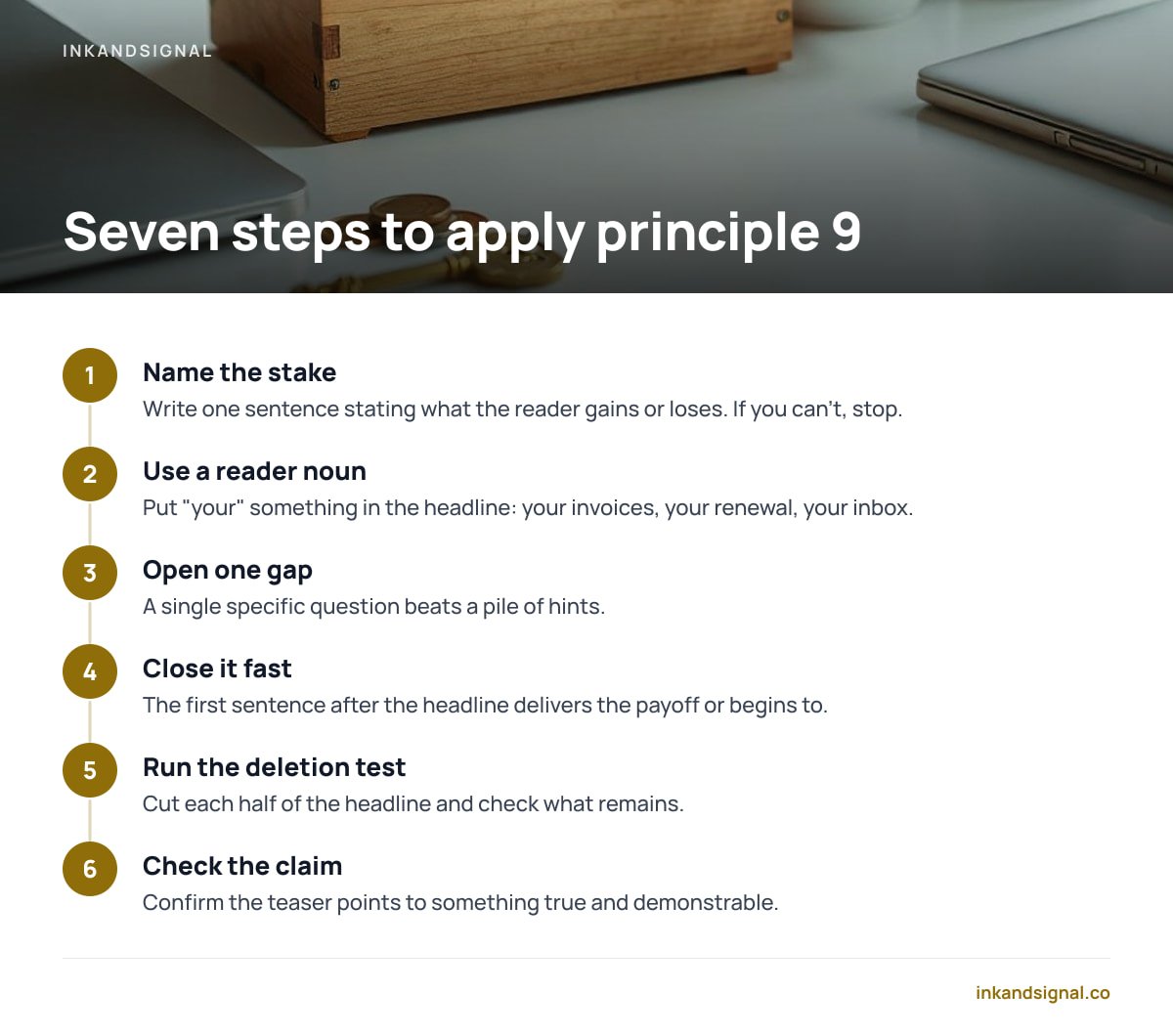
    1. Name the stake. Write one sentence stating what the reader gains or loses. If you can't, stop. The problem is upstream of the headline.
    2. Use a reader noun. Put "your" something in the headline: your invoices, your renewal, your inbox. It is the cheapest stake there is.
    3. Open one gap, not three. A single specific question beats a pile of hints.
    4. Close it fast. The first sentence after the headline delivers the payoff or begins to.
    5. Run the deletion test from the tip above.
    6. Check the claim. Confirm that the teaser points to something true and demonstrable.
    7. Split test two versions. Compare the curiosity-plus-stake version against a plain-benefit version. Measure the downstream action, not just the open or click.

    That last step matters, because a headline can win the click and still lose the sale.

    Seven steps to apply principle 9: 1. Name the stake; 2. Use a reader noun; 3. Open one gap; 4. Close it fast; 5. Run the deletion test; 6. Check the claim

    Get All 100 Field Principles, Not Just Number 9

    Principle 9 is one of 100 in The Direct Response Marketing Playbook from Inkandsignal, a 48-page PDF for $37. It condenses a century of direct-response advertising into 8 masters, 10 systems, 100 principles, 30 example ads and a 30-day campaign build. If you tend to stall at the blank-headline stage, the principles checklist and the example ads give you something concrete to measure your drafts against. A free principle card deck sample lets you test the style before you spend anything.

    The caveat: it is a book of methods, so it will not write your copy, and it can't promise your results, because those depend on your offer and your audience. Check the product page for the exact contents before you buy, and treat every principle, including this one, as a hypothesis to test.

    Frequently Asked Questions

    Are curiosity headlines the same as clickbait?

    No. Clickbait opens a gap and doesn't close it, or exaggerates what is behind it. A curiosity headline that converts points at something real and specific, attaches it to the reader's own interest, and pays it off in the first lines of the body.

    When should I skip curiosity and use a plain benefit headline?

    When the reader is already actively searching for a solution, a clear statement of the benefit usually serves them better. Curiosity helps most when the reader isn't looking, when your promise sounds like everyone else's, or when the mechanism behind the result is the interesting part. Test both against each other to find out for your audience.

    What counts as "meaningful" self-interest?

    Something the reader would spend money, time or worry on: income, savings, status, safety, time back, or avoiding an embarrassing mistake. If the stake would not make the reader change a plan or open their wallet, it is probably only interesting.

    How do I measure whether a curiosity headline converts?

    Track the action you actually want, such as a signup, purchase or reply, and not only opens or clicks. A headline can win the click and lose the sale, so compare versions on the downstream result, with enough traffic to trust the difference.

    Do curiosity headlines work in every channel?

    The principle holds across channels, but the execution varies. Inbox previews and ad feeds truncate text, so the stake should appear early in the line. Search ads and pages that match a specific query often reward clearer benefit-led wording.

    Sources

  • Headlines That Attract the Right Customers (and Repel the Rest)

    Headlines That Attract the Right Customers (and Repel the Rest)

    Headlines that attract the right customers do it by selecting the reader. A headline's job is to make the right reader think "that's me" and let everyone else keep scrolling. A headline that earns a million clicks from the wrong people costs you money; one that earns a hundred from buyers pays for itself. Write for a narrow reader on purpose.

    TL;DR:

    • A headline is a filter first and a hook second: it should name its reader so everyone else can leave.
    • Broad headlines win clicks and lose sales; narrow headlines win fewer clicks and more buyers.
    • Name the reader, the problem, or the situation in the headline itself, using words your customers actually use.
    • Catchy, short, and funny headlines work only when they still carry a selector.
    • Judge a headline by cost per qualified lead or sale, never by click-through rate alone.

    Table of Contents

    The Principle: Let the Headline Select the Right Reader

    Two fishing nets with different mesh sizes hanging next to each other on a wooden dock.

    This is principle 8 of the 100 field principles in Ink & Signal, and it is stated in six words: "Let the headline select the right reader."

    Read it plainly. Before your ad, email, or landing page can persuade anyone, it has to be read by someone who could buy. The headline is the only part guaranteed to be seen, so it does the sorting. It tells the right person to stop and tells the wrong person to move on, which is a service to both.

    Most advice treats a headline as bait: more clicks is better. That gets the economics backwards. You pay for attention in money (ads), reputation (email), or time (content). Attention from people who will never buy is a cost, not a win.

    A headline that turns away 90 percent of readers and converts the other 10 percent beats one that holds everyone and converts none.

    Why a Narrow Headline Beats a Broad One

    A shopkeeper in an apron talks with a customer reaching for a single cast-iron skillet on a tidy counter, next to a cluttered counter of assorted cookware.

    Broad headlines fail for three reasons.

    • They speak to nobody. "Grow your business faster" fits every business, so no owner feels addressed. A person only stops for a message that seems written for their situation.
    • They collect the wrong crowd. Curiosity headlines pull in the idly curious. They click, skim, and leave, and your analytics reward you for it.
    • They blur the offer. If the headline attracts anyone, the page has to serve everyone, and a page that serves everyone persuades no one.

    The classic direct-response writers understood this. In the spirit of Claude Hopkins in Scientific Advertising, an ad is salesmanship, and a salesman who stops every passerby is wasting the day. In the spirit of David Ogilvy, a headline's first duty is to hail the people you want. Neither idea is new. It keeps getting forgotten because click counts are easy to read and sales are not.

    How to Write Headlines That Attract the Right Customers

    In a busy market, one person stops at a stall to talk with the owner while the rest of the crowd walks past.

    A selector can be built from four materials. Use at least one in every headline.

    Name the Reader

    Call out who it is for: "For freelance designers who hate chasing invoices." Direct address is the strongest filter there is. The right reader feels spotted.

    Name the Problem in Their Words

    Use the phrase your customer would type or say aloud, not your internal label. The best raw material is their own language, which is why voice of customer copywriting comes before headline writing, not after.

    Name the Situation

    Context selects as well as identity does: "Just inherited a rental property and no idea what you owe?" The person in that spot knows it instantly.

    Name a Qualifier or Price

    A number or condition screens by budget and fit: "Accounting software for teams under 10 people." The "under 10" repels the enterprise buyer you cannot serve. Specifics also build trust, as covered in specificity in copywriting.

    A Worked Example: Same Product, Two Headlines

    Take a small SaaS company selling scheduling software. Here are two versions of the same landing page headline, shown as a hypothetical to illustrate the principle.

    Headline A Headline B
    Text "Scheduling made simple" "Stop losing no-show appointments: scheduling for solo dental and physio clinics"
    Who it selects Anyone who schedules anything Solo clinic owners with a no-show problem
    Likely clicks High, mixed audience Lower, concentrated audience
    Page it needs Generic, tries to serve all Specific: reminders, deposits, clinic workflows
    What you should measure Cost per click Cost per booked demo

    Headline A will win on click-through rate and probably lose on revenue per visitor. Headline B gives up volume and gains fit. Everything that follows (the subhead, the proof, the call to action) can then speak to one person.

    My pick is Headline B every time, even before testing. If B loses on a proper test of cost per qualified lead, you have learned something real, and you can test the claim rather than guess.

    Measure the headline by cost per qualified lead, not cost per click. A 0.5 percent click rate that books demos beats a 5 percent rate that books none.

    The Mistake That Breaks It: Writing for Clicks, Not Buyers

    The common failure is optimizing for the wrong number. A team tests five headlines, crowns the one with the highest click rate, and ships it. The winner is usually the broadest, vaguest, or most curiosity-driven line, which is exactly the one that selects worst.

    Three habits cause it:

    • Fear of excluding anyone. Writers worry that narrowing loses customers. It loses non-customers, and it makes the remaining ones more likely to act.
    • Cleverness over clarity. A pun or riddle can charm and still fail to say who it is for.
    • Selling the product instead of the destination. A headline that lists features reaches nobody in particular; one that promises an outcome reaches people who want it. See sell the outcome, not the product.

    A quick test: Delete the product name and the brand from the headline. If it still tells a specific reader what problem you solve, it is selecting. If it could sit above any competitor's page, it is not.

    Your Questions, Answered: Short, Funny, Resume, and Dating Headlines

    How to use content to attract customers?

    Let every title do the filtering. Blog posts, emails, and ads should each open with a headline that names the reader and the problem, so the people who arrive are already a fit. Content that attracts everyone builds traffic; content that attracts buyers builds a pipeline.

    How can I write a catchy headline?

    Catchy comes from specificity. Start with the reader and the result they want, then compress. "Fix your no-show problem in one afternoon" is catchy because it is concrete. Write twenty versions, cut the vague ones, and keep the one a stranger would recognize as theirs.

    Short headlines that attract the right customers

    Short works when each word carries a selector. "Invoicing for freelancers" is five words and filters well. "Better business, simplified" is four and filters nothing. Cut filler, never the reader's name.

    Funny headlines that attract the right customers

    Humor selects by sensibility, so it repels some people and bonds with others. Use it when your buyers share an inside joke or a shared pain, and keep the selector intact. A joke with no named reader is entertainment, not advertising.

    What's a good headline for a customer service resume?

    A resume headline is a filter for a recruiter, so name the role, the scale, and one result: "Customer service lead: 40-agent team, 94% satisfaction, SaaS support." Use only figures that are true and that you can back up in an interview.

    What is a good introduction title for a dating site?

    Same principle, different market. A title that could describe anyone attracts everyone and connects with no one. Name something particular: "Sunday-market regular who will absolutely judge your coffee order." The right person replies; the wrong ones scroll on, which is the point.

    A Checklist to Apply This Week

    1. Pick one live headline (an ad, email subject, or landing page) and write who it is for in one sentence.
    2. Check that the headline says it. If the named reader is not in the words, rewrite until they are.
    3. Swap in customer language. Replace your jargon with phrases lifted from reviews, emails, or support tickets.
    4. Add one qualifier. A role, a situation, a size, or a price band.
    5. Remove the brand name and see whether the line still stands alone.
    6. Change the scorecard. Track cost per qualified lead or sale, not clicks.
    7. Run the narrow version against the broad one, and let the numbers pick.

    If you have not yet identified who is worth selecting, start with how to find a hungry market, because a headline can only select a reader you have first chosen.

    Get the 100 Field Principles Behind Better Headlines

    This article is one principle of a hundred. Inkandsignal packs all of them into The Direct Response Marketing Playbook, a 48-page PDF for $37 that covers 8 masters, 10 systems, 100 principles, 30 example ads, and a 30-day campaign build. If your headlines keep earning clicks that never turn into customers, the playbook gives you the checklist, the example ads to study, and a build plan to test against.

    One limit: it is a short, practical PDF, so it will not write your headlines or run your tests, and your numbers will still depend on your offer and your market. A free principle card deck sample is available if you want to judge the style before you buy.

    Frequently Asked Questions

    What makes a headline attract the right customers?

    It names a specific reader, problem, or situation so the right person recognizes themselves and the wrong person moves on. Specific words and customer language do the filtering. Breadth attracts clicks; precision attracts buyers.

    Should a headline try to appeal to as many people as possible?

    No. A broad headline fits nobody in particular and tends to attract browsers instead of buyers. A narrower headline lowers volume but raises the share of readers who act, which usually improves cost per sale.

    How do I know if my headline is attracting the wrong customers?

    Look past click rate to what happens after the click: bounce rate, demo requests, purchases, and the quality of inbound questions. If clicks are high and conversions are low, the headline is probably pulling the wrong crowd.

    Are short or funny headlines ever a good idea?

    Yes, when they still carry a selector. A short headline that names its reader works well, and humor works when your buyers share the joke. Both fail when brevity or cleverness replaces clarity about who the message is for.

    How many headline variations should I test?

    Start with a narrow version against a broad one, since that comparison teaches the most. Measure each by cost per qualified lead or sale, and add variations only when you have enough traffic to see a real difference.

    Sources

  • Eugene Schwartz’s 5 Stages of Awareness, Applied to Real Ads

    Eugene Schwartz’s 5 Stages of Awareness, Applied to Real Ads

    The Eugene Schwartz stages of awareness describe how much your prospect already knows, in five steps: unaware, problem aware, solution aware, product aware, and most aware. Schwartz set them out in his 1966 book Breakthrough Advertising. The rule is simple: the less your reader knows, the further back your message has to begin. Start at the wrong stage and a good offer reads as noise.

    TL;DR:

    • Schwartz's five stages are ordered by what the reader knows: unaware, problem aware, solution aware, product aware, most aware.
    • Each stage has a different opening move. Most aware gets the deal, product aware gets the edge, solution aware gets the result, problem aware gets the problem, unaware gets recognition.
    • Awareness is separate from the marketing funnel and from marketing history: it measures what the reader knows.
    • The usual failure is writing from your own stage, product first, to readers who are several stages behind.
    • Write one opening per traffic source, hold the rest of the page steady, and test.

    Table of Contents

    The Principle in Plain Words: Start Where the Reader Is

    Two people talking across a cafe table, one listening closely while the other gestures as they speak.

    Principle 7 of the 100 in Ink & Signal reads: "Match the message to awareness." In plain words, decide what your reader already knows before you decide what to say.

    It holds for a boring reason. A message is only understood against what the reader already carries in their head. Tell someone the price of a cure they don't know exists and you've said nothing. Explain the problem to someone who has already tried three fixes and you've insulted them.

    The direct-response masters circled this idea for decades. In the spirit of Schwartz, the copywriter doesn't create desire. The copywriter finds desire that already exists and channels it toward a product. Awareness is how far along that channel your reader is standing. If you want the upstream half of that thought, how to find a hungry market covers where the desire comes from.

    The Eugene Schwartz Stages of Awareness, Stage by Stage

    A row of five wooden steps rising in height, standing on a studio floor in soft light.

    The five stages of awareness in marketing, as set out in Breakthrough Advertising, run from the reader who knows nothing to the reader who is ready to buy. They are also the answer to "what are the five stages of consumer awareness?" It's the same list.

    Stage What the reader knows Open with
    Most aware Your product, and wants it The offer: price, deal, deadline
    Product aware Your product exists, but isn't sure it's right What makes it better or different
    Solution aware The result they want, not your product The result itself, then why you deliver it
    Problem aware They feel the pain, not that a fix exists The problem, named precisely
    Unaware Nothing about the problem or you Recognition: who they are, what they believe

    Each stage gets its own opening move, from naming the deal at the top of the table to naming the person at the bottom.

    Two things follow from the table.

    • Distance sets length. In the spirit of Schwartz, the further the reader is from your product, the more ground you must cover before the pitch. Most aware readers can take a two-line email. Unaware readers need a story.
    • The stage belongs to the message. The same human is problem aware when they type a pain into search on Monday and most aware when your discount email lands on Friday. Write for the moment.

    Awareness Compared With the Funnel and Marketing Evolution

    Three lists get mixed up with this one. Keep them apart, because each answers a different question.

    The five stages of the marketing funnel

    The purchase funnel has no single canonical version. A common five-stage form is awareness, interest, consideration, purchase and retention. Its ancestor, AIDA (attention, interest, desire, action), is credited to advertising pioneer E. St. Elmo Lewis in the late 1890s. The funnel tracks where a buyer is in the buying process.

    The five stages of marketing evolution

    Marketing textbooks, Philip Kotler's among them, commonly teach five company orientations: production, product, selling, marketing and societal marketing. This is the history of how businesses thought about customers. It tells you nothing about the person reading your headline.

    Where Schwartz's stages differ

    Schwartz measures knowledge. Someone can be deep in the funnel and still problem aware, such as a buyer comparing vendors who doesn't yet understand what they're comparing. Someone else can be wholly unaware and still be a perfect future customer. Use the funnel to count and the awareness stages to write.

    Worked Example: One Invoicing App, Five Different Openings

    Here's an illustrative composite, not a real client: a small invoicing app for freelancers, $19 a month. The product never changes. Only the opening does.

    Stage Opening line Where it runs
    Unaware "You didn't go freelance to spend Sunday night chasing money." Cold social video
    Problem aware "Late invoices aren't a client problem. They're a follow-up problem." Search for "client won't pay invoice"
    Solution aware "Get paid in days, not months, with reminders that sound like you." Search for "automatic invoice reminders"
    Product aware "Reminders sent from your own email address, so clients treat them as you." Retargeting site visitors
    Most aware "Annual plan, $190 instead of $228, until Friday. Pick up where your trial stopped." Email to expiring trials

    Notice what each line leaves out. The most aware email never explains what an invoice reminder is. The unaware line never mentions software.

    The third line is also the one where selling the outcome rather than the product does the most work. Solution aware readers search for the result, not your brand name.

    Awareness Is One Dial. Market Sophistication Is the Other.

    Hands turning one of two large dials on a vintage control panel in a workshop.

    Schwartz gave a second model in the same book, and it's the reason awareness alone won't finish the job. Awareness asks what the reader knows about you. Sophistication asks how much they have already heard from everyone else.

    His five sophistication stages run from the first claim in a market, to a bigger claim, to a new mechanism, to an expanded mechanism, to identification with the buyer. In a fresh market, a plain promise works. In a crowded one, the same promise reads as the fifth ad this week that said it.

    My position: set awareness first, because it's cheap to diagnose. You know your traffic source. Then adjust for sophistication by reading what competitors already claim. If every rival promises "get paid faster," your solution aware line needs a mechanism, such as "reminders from your own address," to be believed. Specifics also carry more weight than adjectives here, which is the argument in specificity in copywriting.

    The Mistake That Breaks the Principle, and the Case Where the Obvious Fix Is Wrong

    The common mistake is writing from your own stage. You live inside the product, so your instinct is product first: features, pricing, the logo. That works for the most aware and fails for everyone else. Cold traffic doesn't know your name, so a headline built around it asks them to care about something they've never heard of.

    The obvious fix is wrong. "Then target the most aware, since they convert best." They do convert best per visitor, but they are a small pool you mostly already own: past buyers, trial users, people who typed your brand name. Growth lives one or two stages earlier. A business that only writes for the bottom stage gets efficient and stops growing.

    My pick for most small budgets is problem aware and solution aware for cold paid traffic, with most aware kept for email. Unaware campaigns can work, but they need long copy, patient testing and a budget to survive the learning period. I'd start there only if the stages above are already working.

    A cheap test: Change only the first 50 words per traffic source and hold everything below constant. The opening carries the awareness match, so this isolates the variable and keeps the test cheap. Then read the search terms or ad comments that brought each visitor and borrow their phrasing, as described in voice of customer copywriting.

    Whichever stage you target, claims need support. The U.S. Federal Trade Commission's advertising and marketing guidance expects advertisers to have a reasonable basis for what they say before they say it. That matters most at the product aware stage, where bold claims live. Testing marketing claims shows how to prove a claim is true before you prove it sells.

    Pronunciation, the Book, and the Psychology Question

    Pronunciation. Schwartz is said "shworts" in English: "sch" as in "show," "tz" as in "ts."

    The book. Breakthrough Advertising is the 1966 source for both the awareness stages and market sophistication. The chapters on the stages are short. Read those first.

    Psychology. The model is a practitioner's framework, and no validated psychological scale backs it. Its academic cousins are hierarchy-of-effects models such as AIDA. Treat it as a working map that earns its place by forcing a decision.

    A Five-Point Checklist for This Week

    1. List your traffic sources. Ads, search, email, referrals, direct. Write them down.
    2. Assign one stage to each source. Pick the most likely stage, not the hopeful one.
    3. Rewrite only the opening. Change the headline and first paragraph to fit that stage's move from the table.
    4. Cover the product name. If the opening still makes sense to a stranger, it's pitched right for the early stages.
    5. Run it against the old version. Judge on response, not on which one you like more.

    Get All 100 Principles in a 48-Page Playbook for $37

    This article covered one principle out of a hundred. Inkandsignal sells The Direct Response Marketing Playbook, a 48-page PDF for $37 that puts principle 7 beside 99 others, plus 8 masters, 10 systems, 30 example ads and a 30-day, 8-stage campaign build. When you want to apply the awareness match to a real campaign, the build gives you the sequence and the example ads show what each stage looks like on the page. A free principle card deck sample is available if you'd rather read before buying.

    The caveat: it's a condensation. It points you to the masters rather than replacing their books, and it won't tell you which stage your traffic is in. Only your own tests will. Check the contents page before you buy and see whether the ground it covers is the ground you're stuck on.

    Frequently Asked Questions

    What are the 5 stages of awareness in marketing?

    Eugene Schwartz's five stages are unaware, problem aware, solution aware, product aware and most aware. They describe how much a prospect knows about their problem, the possible fixes and your product. Each stage calls for a different opening message.

    How do you pronounce Eugene Schwartz?

    In English the surname is pronounced "shworts." The "sch" sounds like "sh" and the "tz" sounds like "ts."

    Are the stages of awareness the same as the marketing funnel?

    No. The funnel tracks where someone is in the buying process, from awareness through purchase and retention. Schwartz's stages track what the person knows, so a deep-funnel buyer can still be only problem aware.

    What is the difference between awareness and market sophistication?

    Awareness is how much the reader knows about you and the problem. Sophistication is how many similar claims they have already heard from competitors. You need both: awareness sets where your message starts, and sophistication sets how specific it must be to be believed.

    Which awareness stage should a small business write for?

    For cold paid traffic, problem aware and solution aware are the most practical starting points. Reserve most aware messages for email to past buyers and trial users. Unaware campaigns can work but need longer copy and more testing budget.

    Is the stages of awareness model backed by psychology research?

    It is a copywriter's field framework rather than a validated psychological scale. Its academic relatives are hierarchy-of-effects models such as AIDA. Treat it as a working map and verify it with your own response data.

    Sources

  • Unique Mechanism in Marketing: Make It Easy to Explain

    Unique Mechanism in Marketing: Make It Easy to Explain

    A unique mechanism in marketing is the specific, believable reason your product delivers its result. It is the "how" behind the promise. A unique value proposition says what the customer gets, and a USP says why they should pick you over a rival. The mechanism explains why the promise is true. It only works if a customer can repeat it to a friend in one sentence. A mechanism that needs a diagram persuades nobody.

    TL;DR:

    • A unique mechanism is the "how" behind your promise. It is separate from the benefit and the brand: it is the reason the benefit is believable.
    • The test is simple: a customer should be able to explain your mechanism to a friend in one sentence, with no jargon.
    • Claude Hopkins showed with Schlitz that a mechanism doesn't need to be exclusive. It needs to be explained first and plainly.
    • The most common failure is a mechanism built to sound impressive, such as "proprietary AI-driven engine," that nobody can repeat or verify.
    • Every mechanism is a factual claim. Regulators like the FTC expect you to be able to back it up before the ad runs.

    Table of Contents

    What a Unique Mechanism in Marketing Actually Is, and What It Isn't

    Most pages that rank for this topic blur three different ideas together. If you separate them, you will write better copy.

    A unique value proposition (UVP) is the specific value a customer gets from you that they can't get as easily elsewhere. It is about the outcome: "Close your books in a day instead of a week." A unique selling proposition (USP) is Rosser Reeves's term from Reality in Advertising (1961). It means a single benefit-led proposition that competitors cannot or do not offer. A unique mechanism is the reason the outcome happens. It is the part of the product, process, or method that makes the promise believable.

    Term Answers the question Example (invoicing software) Fails when
    UVP What do I get? "Get paid 2 weeks faster." It's a vague benefit anyone could claim
    USP Why you, not them? "The only tool that chases late invoices for you." A rival can copy it next quarter
    Unique mechanism Why should I believe it works? "It texts the client a pay-now link the morning an invoice goes overdue." Nobody can repeat it after reading it

    The order matters. A UVP without a mechanism reads like a boast. A mechanism without a UVP reads like a spec sheet. Put them together and you have an argument. If you haven't pinned down the outcome yet, start with selling the destination rather than the vehicle. The mechanism is what gets the reader to that destination.

    Principle 6: Why "Make the Mechanism Easy to Explain" Holds

    A person demonstrates an idea with a coffee mug and spoon on a kitchen counter as a friend watches closely.

    This is day 6 of the series, and principle 6 of the 100 field principles in Ink & Signal reads: "Make the mechanism easy to explain."

    A mechanism has two jobs. First, it has to convince the buyer. Then it has to convince the buyer's spouse, boss, or business partner, usually without you in the room. The buyer becomes your salesperson. They can only make that pitch if they can repeat the reason.

    Ease of explanation also protects you against how people actually read. Nielsen Norman Group's research on how users read on the web found that most people scan pages rather than reading them word by word.

    79% of test users scanned any new page; only 16% read it word by word. Your mechanism has to survive being skimmed.

    A mechanism that takes three paragraphs to set up will be missed by four out of five readers. A mechanism that fits in a subhead will reach most of them.

    A simple mechanism is also easier to check. When the claim is concrete ("a text goes out at 8 a.m. the day it's overdue"), the reader can picture it and test it in their head. A reader who can verify a claim tends to believe it. An abstract mechanism asks the reader to trust you. A concrete one lets them check for themselves.

    What the Masters Got Right: Hopkins, Reeves and Schwartz

    An old wooden desk with a fountain pen, a glass inkwell and a brass lamp lit by warm sunlight.

    The classic direct-response writers didn't use today's vocabulary. Still, three of them shaped how practitioners think about mechanisms.

    Claude Hopkins and the bottles everyone washed

    In My Life in Advertising (1927), Hopkins described touring the Schlitz brewery. He saw the deep wells, the filtering, and the bottles sterilized before filling. The brewers told him every brewery did this. Hopkins's point was that no brewer had ever explained it to the public. So he did.

    Every brewer purified its water and sterilized its bottles. Schlitz was the one that told the public how.

    The lesson goes against what most people assume. Your mechanism does not have to be exclusive to you. It has to be explained by you, first, in words a customer can repeat. Many "unique" mechanisms are really common practices that nobody else bothered to describe.

    Rosser Reeves and the one proposition

    Reeves insisted that an ad make one proposition, and that the proposition be strong enough to move people. The M&M's line "melts in your mouth, not in your hand," credited to Reeves's agency, is a mechanism-led promise in seven words. The candy shell is the mechanism. The clean hand is the benefit.

    Eugene Schwartz and the tired market

    In Breakthrough Advertising (1966), Schwartz described markets that pass through stages of sophistication. When buyers have heard every direct claim, he argued, a new mechanism gives the old promise new life. This is the strongest argument for mechanisms, and also the strongest warning: in a sophisticated market, buyers have heard many mechanisms, and they reject the ones they can't follow.

    A Worked Example: Rewriting a No-Show Landing Page

    Here is a composite example, not a real client: a scheduling tool sold to dental clinics. The buyer is a practice manager whose problem is empty chairs from patients who don't show up.

    The original hero section read like many SaaS pages do:

    Before: "AI-powered patient engagement platform that intelligently optimizes your schedule."

    That sentence has no mechanism, only adjectives. Ask the practice manager to explain it to the dentist who signs the check, and the best they can manage is "it's some AI thing for the schedule."

    The rewrite starts from what the product actually does:

    After: "Patients confirm with one tap. Anyone who hasn't confirmed 48 hours out gets their slot offered to your waitlist."

    Element Before After
    Mechanism stated? No Yes: tap-to-confirm plus automatic waitlist release
    Can the reader picture it? No Yes: a text, a tap, a slot moving
    Explain-back sentence "It's AI for scheduling." "It texts patients and gives unconfirmed slots to the waitlist."
    Claim you must substantiate Vague, hard to test Specific: timing and waitlist logic must work as described

    The explain-back sentence is the real test. The rewritten version passes because the practice manager can say it to the dentist in the hallway. Notice that the mechanism also implies the benefit. Fewer empty chairs follows on its own, so the subhead can say it outright without sounding like a boast.

    The mechanism also gives the follow-up email a subject line: "What happens when a patient doesn't tap confirm." That email explains one step and links to a two-minute demo of the text arriving. One mechanism can carry an ad, a page, and a sequence.

    A test worth running: Prove your mechanism is doing work by testing a version without it. Run the page with the mechanism line, and run it again with only the benefit line. If conversion doesn't change, your mechanism is decoration, either because readers don't believe it or because they never noticed it. Rewrite it rather than adding more of it. The full method is in testing marketing claims: prove it's true, then prove it sells.

    The Mistake That Breaks It: Mechanisms Nobody Can Repeat

    A person shows off a complicated gadget made of gears and springs to a confused-looking listener.

    The most common way to break principle 6 is to name the mechanism after the engineering instead of the experience. You've seen these names: "NeuroSync adaptive engine," "proprietary multi-layer optimization framework." They sound expensive, and nobody can repeat them.

    Three versions of this mistake show up again and again:

    • The branded black box. You trademark a name for the mechanism but never explain what it does. A name is not an explanation. "Our TriFold Method" means nothing until you say what the three folds are.
    • The stacked mechanism. You list five reasons it works, so the reader remembers none of them. Pick the one they can see, and cut the other four or move them to the FAQ.
    • The "AI-powered" placeholder. "AI" has become the default mechanism for products that haven't found their real one. It is also a claim regulators watch. The FTC's business guidance on AI claims warns advertisers against exaggerating what an AI product can do or claiming a product uses AI when it doesn't.

    Underneath all three is a bigger point: a mechanism is a factual claim. The FTC's advertising guide for small businesses says ads must be truthful and not misleading, and that advertisers need evidence to back up objective claims. In the UK, the CAP Code enforced by the Advertising Standards Authority requires marketers to hold documentary evidence for objective claims before an ad runs. A plainly stated mechanism helps you here, because it's obvious what you need to prove. A vague one hides the problem until a regulator or a refund queue finds it.

    The fix is to use your customers' words. When customers describe why your product works, they rarely use your product team's terms. Start with voice of customer copywriting: read reviews and support tickets until you find the sentence buyers already use. That sentence is usually your mechanism.

    Where the Mechanism Sits in the 7 Steps of Advertising

    No single standard "7 steps of advertising" exists. Textbooks and agencies number the process differently. Here is a sequence a practitioner can use, with the mechanism in its place:

    1. Find the market. Confirm people already want the outcome and are spending money to get it. See how to find a hungry market.
    2. Define the buyer. Name the one person who reads the ad and the one person they have to convince.
    3. Set the objective. Pick one measurable action, such as a click, trial, call, or sale.
    4. Build the message. Write the UVP, then the mechanism that makes it believable, then the proof. This is where principle 6 applies.
    5. Choose the media. Match the channel to how much explanation the mechanism needs. A one-line mechanism fits a search ad. A two-step mechanism needs a landing page.
    6. Launch and test. Run versions with and without the mechanism, and with different phrasings of it.
    7. Measure and iterate. Keep the version that sells, write down why, and start the next test.

    Most teams skip from step 1 to step 6 and wonder why the ads sound like everyone else's. Step 4 is where a campaign becomes distinct.

    Seven steps of advertising, mechanism included: 1. Find the market; 2. Define the buyer; 3. Set the objective; 4. Build the message; 5. Choose the media; 6. Launch and test

    Will AI Replace Marketing, and What Kind of Person Is Good at It?

    Will marketing be replaced by AI?

    No, but AI will replace a lot of marketing production. Drafting variants, resizing creative, and summarizing reviews are already cheap and getting cheaper. What AI does not do on its own is pick which mechanism is true, which one a buyer will believe, and which one you can substantiate if challenged. Those are judgment calls with legal and commercial consequences. My position: use AI to generate twenty phrasings of your mechanism, and use a human to decide which one is accurate. The marketers at risk are the ones whose whole job was producing more copy. The ones who choose what the copy claims are not.

    What type of person is good at marketing?

    The people who do well at response-focused marketing share four habits:

    • They are curious about people. They read support tickets and reviews for pleasure, because that's where the mechanism hides.
    • They are comfortable with numbers. They'd rather know an ad lost than assume it won.
    • They write plainly. They can say what a product does in one sentence without reaching for an adjective.
    • They tolerate being wrong. Most tests lose. Good marketers treat a losing test as information, not as a personal failure.

    Charisma and a big creative vocabulary are optional. A willingness to be checked against results is not.

    Your Checklist for This Week

    Apply principle 6 to one live asset before Friday:

    • Write the explain-back sentence. Finish this sentence: "It works because ___." Use 15 words or fewer and no product terms.
    • Read it to someone outside your company. Ask them to repeat it back an hour later. If they can't, rewrite it.
    • Replace one adjective with one step. Swap "intelligent" or "advanced" for a visible action the product takes.
    • List the evidence. Next to the mechanism, write down what you'd show a regulator or a skeptical buyer to prove it.
    • Move it up the page. The mechanism belongs in the headline or the first subhead, not in paragraph six.
    • Test it. Run one version with the mechanism and one with the benefit alone, and let the numbers decide.

    Get 100 Principles You Can Check a Campaign Against in an Afternoon

    Principle 6 is one of a hundred. Most campaigns that underperform break several principles at once, often without anyone noticing. Inkandsignal put all of them into The Direct Response Marketing Playbook, a 48-page PDF for $37. It condenses eight direct-response masters into ten systems and the 100 Principles checklist. It also includes 30 example ads showing mechanisms done well and badly, and a 30-day, 8-stage campaign build that puts the message step where it belongs. If you want to try it before buying, the free principle card deck sample lets you test the format first.

    The caveat: the playbook is a method and gives no guarantee. It can show you how to state a mechanism clearly. It cannot make your mechanism true or substantiate it for you, and its example ads illustrate the method without promising your results. Treat every principle, ours included, as something to test against your own numbers.

    Frequently Asked Questions

    What is a unique mechanism in marketing?

    A unique mechanism is the specific reason your product delivers the result you promise: the "how" behind the benefit. It makes the promise believable by showing the process, ingredient, or step that produces the outcome. The best mechanisms can be explained by a customer in one sentence.

    What is a unique value proposition (UVP)?

    A unique value proposition is a clear statement of the specific value a customer gets from you that they can't easily get elsewhere. It focuses on the outcome, such as "get paid two weeks faster," rather than features. A UVP works best when it is paired with a mechanism that explains why the outcome is real.

    Does a unique mechanism have to be exclusive to my product?

    No. Claude Hopkins's Schlitz campaign explained purification and bottle-sterilizing steps that other brewers also used. Being the first to explain a process plainly can be as persuasive as owning it, as long as you don't claim exclusivity you don't have.

    How do I know if my mechanism is too complicated?

    Ask someone outside your company to read it and then repeat it back an hour later. If they can't explain it in a sentence without your product terms, it's too complicated. Rewrite it around a step the customer can picture.

    Do mechanism claims need to be backed up legally?

    Yes. A mechanism is a factual claim about how a product works. The FTC expects advertisers to have evidence for objective claims, and the UK's CAP Code requires documentary evidence before an ad runs. Write mechanisms you can prove, and keep that proof on file.

    Sources

  • Specificity in Copywriting: Why Proof Beats Hype Every Time

    Specificity in Copywriting: Why Proof Beats Hype Every Time

    Specificity in copywriting means replacing claims a reader has to take on faith with details they can picture, check, or test: a number, a name, a mechanism, a deadline. The split that matters is supported versus unsupported, not specific versus vague. "Fastest delivery" is hype. "Ships in 48 hours from Ohio" is a promise someone can hold you to, and that accountability is why readers believe it.

    TL;DR:

    • Specific copy works because readers discount superlatives before they finish reading them, and a checkable detail survives that discount.
    • The fast test is portability. If a competitor could paste your sentence onto their page unchanged, it is hype.
    • Puffery is legally safer than specifics, because objective claims need evidence under both FTC guidance and the UK CAP Code. Do the proof work anyway.
    • The common failure is fake precision, or precision about the wrong thing. Be specific about the doubt your buyer actually has.
    • This week, rewrite one headline, one subject line, and one offer using a number, a mechanism, or a named outcome you can prove.

    Table of Contents

    What Specificity in Copywriting Means, and What It Doesn't

    Principle 5 of the 100 field principles in this series reads, in full: "Specificity beats unsupported hype." Two words in it carry the weight. "Specificity" means a detail the reader can picture or verify, such as a figure, a timeframe, a named ingredient, a named customer, or a mechanism. "Unsupported" means the claim arrives with nothing behind it: no number, no proof, and no reason to believe it.

    Enthusiasm still has a place, and not every sentence needs a statistic. A headline can be bold as long as it is bold about something the reader can check. "The best invoicing app for freelancers" is loud and empty. "Get paid an average of 11 days sooner" is just as confident, and it gives a reader something to test, provided the number is real.

    The quickest diagnostic is portability. Ask whether a competitor could paste your sentence onto their own site without changing a word. "Quality you can trust" fits on anyone's homepage. "Every board is kiln-dried before we cut it, so your table won't warp in its first winter" belongs to one workshop. If your line is portable, it is hype, however well it scans.

    Why Specific Claims Outsell Big Ones: The Three Mechanisms

    A shopper in a hardware store weighs two cordless drills in their hands, comparing them side by side.

    Claude Hopkins made this case in Scientific Advertising (1923), in a chapter titled "Being Specific." His most quoted line from it is "Platitudes and generalities roll off the human understanding like water from a duck. They leave no impression whatever." His argument was that readers expect sellers to exaggerate and mark down superlatives as soon as they hear them. A definite statement escapes that markdown because it sounds like a fact, not a boast.

    Hopkins's best-known demonstration, recounted in his memoir My Life in Advertising, was for Schlitz beer. Every brewer was then shouting "pure." Hopkins toured the brewery and wrote about what he saw: beer cooled in rooms of filtered air, bottles washed with live steam, and water drawn from deep artesian wells. Rival brewers did much the same. None of them had said it. The brand that described its process in detail took the claim that everyone else had only asserted.

    Specifics signal that you know the subject

    A vague claim could come from anyone. A detail like "machined to 0.01 mm tolerance" or "reminder emails go out on day 7, 14 and 30" implies that the writer has been inside the product. Readers treat that knowledge as evidence of competence, often before they have checked a single fact.

    Specifics are falsifiable, so they borrow credibility

    A specific claim can be shown to be wrong. That risk is the source of its power. Readers reason, mostly without noticing, that nobody would print something checkable unless it were true. "Best" carries no risk, so it earns no trust.

    Specifics give the brain something to hold

    Abstract nouns slide past. Concrete images stick. Nielsen Norman Group tested this on the web in its study of how users read online, comparing a promotional version of a page against one written in neutral, objective language.

    Removing promotional language alone improved measured usability by 27% in Nielsen Norman Group's study, and that was before a single new fact was added.

    A Worked Example: Rewriting an Invoicing App's Landing Page

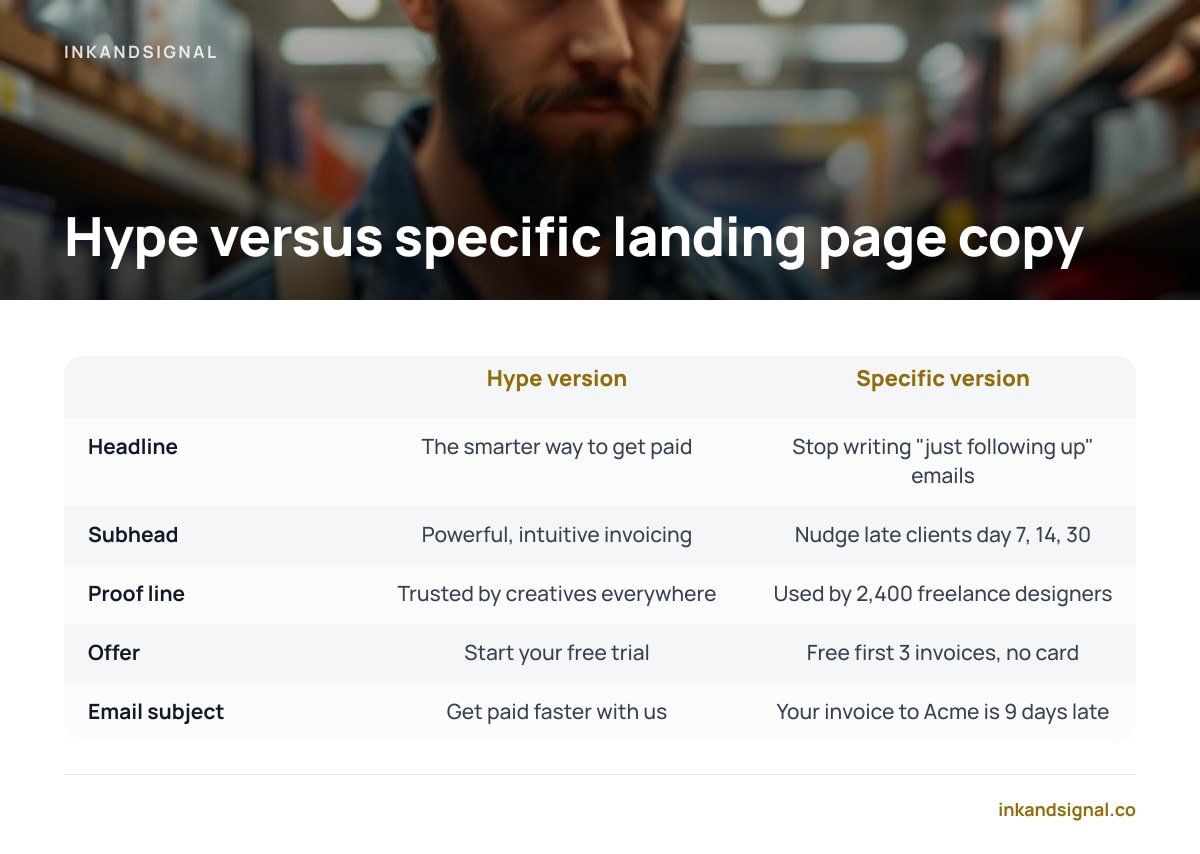
    Take a hypothetical but entirely typical small SaaS product: an invoicing tool for freelance designers. The current hero section reads "The smarter way to get paid. Powerful, intuitive invoicing that saves you hours." Every word of it is portable. A payroll app, a bank, or a spreadsheet template could use it unchanged.

    The rewrite starts with a question: what does a freelancer actually dread? Not the invoicing itself. It is chasing a client who is 30 days late, and the awkward email that comes with it. So the specifics should go there.

    Element Hype version Specific version What it must be backed by
    Headline The smarter way to get paid Stop writing "just following up" emails Automated reminders that actually exist
    Subhead Powerful, intuitive invoicing We nudge late clients on day 7, 14 and 30, from your own email address The real reminder schedule in the product
    Proof line Trusted by creatives everywhere Used by 2,400 freelance designers (example figure) A live, current customer count
    Offer Start your free trial Free for your first 3 invoices. No card needed Billing logic that matches the promise
    Email subject Get paid faster with us Your invoice to Acme is 9 days late A trigger tied to real invoice data

    Look at the subject line in the last row. It names the client, the number of days late, and the problem, and it takes no effort to read. The hype version asks the reader to believe something. The specific version tells them something they need to know right now.

    Pro Tip: Write the specific version first, then check whether you can prove it. If you can't, the fix is almost never a softer adjective. It is usually a change to the product or the offer. If you can't honestly write "reminders on day 7, 14 and 30," build the reminders. Copy that exposes a gap in the product is doing its job.

    Hype versus specific landing page copy: Headline: The smarter way to get paid / Stop writing "just following up" emails; Subhead: Powerful, intuitive invoicing / Nudge late clients day 7, 14, 30; Proof line: Trusted by creatives everywhere / Used by 2,400 freelance designers; Offer: Start your free
    A shop owner's hands set a bag of coffee beans on a brass balance scale opposite a row of small brass weights.

    The competing articles skip one fact: vague copy is the legally safer choice. The UK's CAP Code allows "obvious exaggerations ('puffery')" that the average consumer is unlikely to take literally. It then requires marketers to hold documentary evidence for any claim consumers are likely to regard as objective.

    Under rule 3.7 of the UK CAP Code, you must hold documentary evidence before publishing any claim a consumer would read as objective. "Best coffee in town" needs none. "Roasted 48 hours before it ships" does.

    The US position runs along the same line. The Federal Trade Commission's advertising guide for small businesses states that advertisers must have evidence to back up their claims. The FTC's broader advertising and marketing guidance makes clear that the claim the regulator cares about is the one a reasonable consumer takes away, not the one you meant.

    So the answer that looks obvious, "add numbers and you'll be more persuasive," is incomplete. Numbers add persuasion and liability together. Copy that is safest in legal terms is also the copy that sells least. Take the specificity and do the proof work. Keep the evidence file before launch, not after a complaint. The method for that is in testing marketing claims: prove it's true, then prove it sells.

    The Common Mistake: Being Precise About the Wrong Thing

    Most copy that fails this principle is specific in a way that misses the point.

    • Fake precision. "Boosts productivity by 43.7%" with no source reads as invented, because it usually is. An unrounded number only helps when the real figure happens to be unrounded. Don't manufacture decimals.
    • The spec dump. "8-core processor, 16 GB RAM, 1 TB SSD" is specific, but it is specific to the engineer. The buyer's question is "Will it export my 4K video without freezing?" Translate the spec into the outcome it delivers.
    • Specific about yourself, vague about them. "Founded in 2009, 14 staff, three offices" answers questions nobody asked. Point your specifics at the doubt that stops the purchase: price, risk, effort, time to result. The quickest way to find that doubt is in the customer's own words, which is why voice of customer copywriting comes before the draft.
    • Stacking every detail. Ten specifics in one paragraph turn into noise. Use one sharp detail per claim and let it carry the weight.

    What "Precision in Writing" Means, and How to Build the Skill

    Close-up of hands carefully sharpening a pencil with a small knife beside a wastebasket overflowing with crumpled paper.

    Precision in writing means using the exact word, figure, or example that fits the claim, so the reader cannot take away a wider or vaguer meaning than you intended. "Soon" is imprecise. "By Thursday" is precise. In copy, precision is how specificity shows up at the level of the sentence: one meaning, stated once, with nothing to interpret.

    The skill builds through repetition on real material. This is the routine we would pick over any course:

    • Hand-copy one proven ad a day. Writing out long-form direct-response ads by hand slows you down enough to notice where the specifics sit and what they replace.
    • Rewrite one live piece of copy a day. Take a headline from your own site or inbox. Remove every adjective, then put back only the details you can prove.
    • Interview one customer a week. Most generic copy comes from writers who have never heard a buyer describe the problem. Specific phrases come from people, not from thesauruses.
    • Ship a test every week. A rewrite that never meets an audience teaches you nothing. Split-test a subject line. It is the cheapest experiment in marketing.

    Is Copywriting Still Worth It in 2026, and Can It Pay $5,000 a Month?

    Copywriting is still worth learning in 2026, though it is a different skill from five years ago. Generic, competent-sounding text now costs almost nothing to produce, so it is worth almost nothing. What stays scarce is copy grounded in specific knowledge of a product, a market, and a customer's exact objection. That is this article's principle applied to the career itself: the portable writer gets replaced, and the specific one gets hired.

    Earning $5,000 a month from copywriting is realistic for some writers. It isn't a default outcome, and no honest source can promise it. The arithmetic is simple. Five retainer clients at $1,000 a month gets you there, and so do two launch projects at $2,500. What separates writers who reach that figure from those who don't is usually niche and proof, not talent. "I write email sequences for Shopify skincare brands, and here are three results with numbers" wins briefs that "I'm a versatile copywriter" never sees. Before you pitch, it helps to know how to find a hungry market, for your services as much as for your clients' products.

    Your Specificity Checklist for This Week

    Run each item against one real asset you already have live:

    1. Run the portability test on your headline. If a competitor could use it word for word, rewrite it around one detail only you can claim.
    2. Name the doubt. Write down the single objection that stops your buyer. Make sure your most specific line answers that objection and not some other one.
    3. Replace one adjective with one number. "Fast" becomes a time. "Affordable" becomes a price or a cost per use. "Popular" becomes a count you can verify.
    4. Build the evidence file. For every objective claim, save the source (dashboard screenshot, test result, invoice data) before the copy goes live.
    5. Test one subject line. Send the hype version and the specific version to two halves of a list. Let the response decide, not your taste.

    Get 100 Principles You Can Test, Not Just Admire

    If this checklist felt useful, the full system works the same way across the whole campaign. Inkandsignal publishes The Direct Response Marketing Playbook, a 48-page PDF for $37. It condenses eight direct-response masters into 10 systems and 100 principles like this one, with 30 example ads showing specificity, offers, and proof at work, and a 30-day, eight-stage campaign build that turns the principles into something you ship.

    One limit: it is a playbook, not a done-for-you service. It will show you how to rewrite "the smarter way to get paid" into a line that sells. It cannot supply the proof behind your claims, and it cannot run your tests for you. If you want to try the method before buying, start with the free principle card deck sample on the Ink & Signal site.

    Frequently Asked Questions

    What is specificity in copywriting?

    Specificity in copywriting is the practice of replacing vague or superlative claims with concrete details a reader can picture or verify, such as numbers, timeframes, mechanisms, or named outcomes. It works because readers discount generic boasts but tend to accept definite, checkable statements. The detail has to be true and provable for the effect to hold.

    Why does specific copy convert better than hype?

    Specific claims can be shown to be wrong, so readers assume a seller would not print one unless it were true. Concrete details also show knowledge of the product and are easier to remember than abstract praise. Superlatives like "best" or "powerful" carry no risk for the seller, so they earn little trust.

    Can copy be too specific?

    Yes, when the details answer questions the buyer never asked or pile up into noise. A list of technical specs or company history is specific but often irrelevant to the purchase decision. Aim for one sharp detail per claim, pointed at the objection that actually stops the sale.

    Do specific advertising claims need proof?

    Generally, yes. In the US, the FTC says advertisers must have evidence to back up their claims. In the UK, the CAP Code requires documentary evidence for claims consumers are likely to see as objective. Obvious puffery gets more latitude, which is why vague copy is legally safer but usually less persuasive.

    How do I make a vague headline more specific?

    Start by naming the single doubt or pain your buyer has, then replace every adjective with a detail that addresses it, such as a time, a price, a count, or a mechanism. Check whether a competitor could use the line unchanged. If they could, keep revising until the sentence could only describe your offer.

    Sources

  • Sell the Outcome, Not the Product: Destination Over Vehicle

    Sell the Outcome, Not the Product: Destination Over Vehicle

    To sell the outcome, not the product, means your ad leads with the change the buyer gets (the destination) rather than the specifications of the thing delivering it (the vehicle). A drill ad about torque and battery voltage is selling the vehicle; one about a shelf hung perfectly level in an afternoon is selling the destination. The distinction matters because readers skim features but stop for a problem they recognize as their own.

    TL;DR:

    • The product is the vehicle; the result the buyer wants is the destination. Lead with the destination.
    • Solution selling improved on feature-dumping but still centers the solution; outcome-selling centers the buyer's life after the sale.
    • A Unique Selling Proposition works because it states an outcome a competitor can't or won't claim, not a feature they haven't copied yet.
    • The common mistake is reverting to specs under pressure, whether in a demo, a spec sheet, or a founder's own copy edits.
    • "You are the product" and "sell the outcome" are the same rule from two sides: every audience, paying or not, still gets sold a destination.

    Table of Contents

    The Difference Between a Vehicle and a Destination

    A toy car and a car key placed on a table near a small paper flag standing upright.

    Nobody wants a drill. They want a hole exactly where they marked it, a shelf that doesn't sag, a Saturday afternoon that ends with the job done instead of started. Harvard Business Review's reprint of Theodore Levitt's "Marketing Myopia" is where the quarter-inch-drill, quarter-inch-hole framing is usually traced, and it has outlasted sixty-odd years of marketing fashion because it describes something true about attention, not a trick for writing headlines.

    "People don't want a quarter-inch drill. They want a quarter-inch hole." That one line explains more about conversion than most funnels do.

    Elmer Wheeler, the sales trainer whose seminars shaped a generation of American retail pitching, built his reputation on a related line: sell the sizzle, not the steak. The steak is the product sitting on the plate. The sizzle is the anticipation (the smell, the sound, the appetite) that makes a person reach for their wallet before the first bite. Ink & Signal's principle four states the same idea in two words: "Sell the destination, not the vehicle." Your product is always a vehicle. The reader is always trying to get somewhere else. An ad that describes the vehicle in loving detail, while the reader is staring at the destination, loses every time to an ad that does the opposite.

    What "Solution Selling" Really Means, and Where It Falls Short

    A hand holding a wrench beside a disassembled faucet on a workbench.

    Solution selling is a real methodology. Michael Bosworth popularized the term with his 1994 book of the same name, and the core move is simple: instead of pitching a fixed catalog item, a salesperson diagnoses the customer's specific problem first and assembles a tailored combination of products and services as the "solution." It was an improvement over the feature-dump sales calls that preceded it, and most competent B2B sales training still runs on some version of it.

    Where solution selling falls short is that it still makes the solution the hero. The unit being sold is the bundle, the package, the configured product, just assembled more thoughtfully than before. Selling the outcome goes one step further and asks the salesperson, or the copywriter, to stop defending the shape of the solution at all. If the customer's actual destination can be reached with less of what you sell, say so. That is a harder sell internally than it is externally, which is why most companies never do it.

    Sell the Outcome, Not the Product: A Worked Example

    Worn running shoes resting next to a stopwatch on an outdoor running track.

    Grammarly is a useful real-world case because the underlying technology is complicated (natural-language processing, grammar rules, tone models), and the company has mostly chosen not to talk about any of it on the front end. Its marketing, from browser-extension install pages to in-app prompts, leans on language about writing with confidence and sounding like yourself at your best, not on the mechanics of how a suggestion gets generated. The product pages show a messy sentence turning into a clean one, framed as a moment of relief, not a feature demo.

    That's the destination: the feeling of sending an email you don't immediately regret. The vehicle is a browser extension running a language model. A version of this same ad written by an engineer, or a founder on a bad day, reads: "Advanced AI grammar and tone detection, now with 50+ writing styles." Technically accurate, and dead on arrival, because it answers a question nobody asked.

    Where This Breaks

    • The founder rewrites the landing page. Under deadline pressure, whoever built the product tends to default to describing it, because they know it best and are proudest of the parts that were hardest to build.
    • Sales reverts to the demo. A thirty-minute call that was supposed to confirm a result turns into a feature tour, because showing the interface feels like proof and talking about outcomes feels like promising.
    • The team confuses "benefit" with "outcome." "Saves you three hours a week" is closer than a spec sheet, but it's still describing the vehicle's fuel economy. The destination is what the buyer does with those three hours.
    • Testimonials get edited for polish. Real customer language about the outcome, in the actual words a buyer used, gets smoothed into marketing-speak, which is the fastest way to lose what made it believable in the first place. The guidance in Voice of Customer Copywriting: Steal Their Words First addresses this failure mode.

    Pro Tip: Test an outcome headline against a feature headline without showing anyone your logo. Strip both down to plain text and ask a stranger which one they'd expect to cost more. The version that reads as more expensive is almost always the one describing a result, not a mechanism, which tells you something about pricing power long before you tell them a number.

    The "You Are the Product" Problem, and Why Outcome-Selling Avoids It

    The phrase "if you're not paying for the product, you are the product" describes a real asymmetry: on free platforms, the money changes hands between the platform and advertisers, and the user's attention and data are what's actually being sold in that transaction. Some read this as a contradiction of outcome-selling. It is the same rule applied twice, to two different audiences.

    The platform still has to sell the user a destination (connection, entertainment, status, information) or the user leaves and there's nothing left to sell advertisers. It also sells advertisers a different destination: reach, attention, a buyer at the moment they're ready. Neither pitch is made in terms of the vehicle. Nobody signs up for a social network because of its database architecture, and no advertiser buys a placement because of the recommendation algorithm's training data.

    Your USP Is the Outcome, Stated So No One Else Can Say It

    A Unique Selling Proposition, a term credited to advertising executive Rosser Reeves and laid out in his biography at Encyclopedia Britannica, is a specific, ownable claim about what a product does that a competitor either hasn't said or genuinely can't say. Reeves's own work gives the clearest example still in circulation: M&M's "melts in your mouth, not in your hand."

    "Melts in your mouth, not in your hand" sold a clean hand, not a candy formula, and it never mentions the vehicle.

    The line says nothing about the chocolate's ingredients, the shell's thickness, or the manufacturing process that makes the coating possible. It names a problem every other chocolate had (melted mess, ruined pockets) and claims the solved version of that problem as the brand's territory. That's a USP built entirely from the destination. Most companies, asked to write their USP, write a feature comparison instead, which is a different exercise under the same name.

    The 3-3-3 Rule, and Why It's a Guide, Not a Law

    You'll see a "3-3-3 rule" cited across marketing circles, but it isn't a measured standard the way a safety regulation is, and no single eye-tracking study pins the number at exactly three. The version that holds up as useful shorthand goes like this: a reader decides whether to keep going in roughly the first three seconds, the next three sentences have to give them a concrete reason to stay, and the offer itself needs to land on about three outcomes the reader can picture, not ten features they'd have to study.

    Nielsen Norman Group's research on how people actually read on the web backs the spirit of this without using the number: most visitors scan rather than read, and they scan for words that match something they already want, not for comprehensive information. The 3-3-3 rule is a mnemonic for that finding. Treat it as a rough budget for the reader's patience, not a formula to hit precisely.

    A Short Checklist to Apply This Week

    Step Vehicle language (cut this) Destination language (write this instead)
    Headline "48-page PDF with 100 principles" "An ad that pays for itself before the month ends"
    First bullet "Includes 10 proven systems" "Stop guessing which part of the ad is losing you the sale"
    CTA "Download now" "Start the 30-day build tonight"
    Testimonial edit Polished, generic praise The customer's own words about what changed, kept intact
    • Read your own homepage headline out loud, then ask what it's describing. If the answer is a feature of your product, you're selling the vehicle.
    • Find one past customer's unedited words about the result they got. Use their actual sentence, not a summary you wrote. If you don't have one on file, finding where that language lives before you write the ad comes before any copy revision.
    • Cut every sentence that starts with "our product has." Rewrite it starting with "you'll" or "you won't have to."
    • Run the stranger test from the Pro Tip above on your current headline against one stripped of all feature language.
    • Check the claim is actually true before you ship it. An outcome promise that doesn't hold up under testing is worse than a boring feature list, because it costs you the sale and the trust.
    Vehicle language versus destination language: Headline: 48-page PDF with 100 principles / An ad that pays for itself; First bullet: Includes 10 proven systems / Stop guessing what's losing the sale; CTA: Download now / Start the 30-day build tonight; Testimonial edit: Polished, generic praise / Cust

    Build Thirty Days of Outcome-Led Ads Instead of Guessing

    If this principle convinced you but you're staring at a blank page, Inkandsignal built The Direct Response Marketing Playbook for that gap: a 48-page PDF, $37, that walks through 8 classic direct-response masters, 10 systems, 100 field principles like this one, 30 real example ads, and a 30-day, 8-stage build you can run against your own offer.

    One caveat: it's a method, not a guarantee. No PDF writes your USP for you, and no checklist replaces the unedited customer words you still have to go find yourself. If you want to test the format before paying for it, the free principle card deck sample covers a handful of principles the same way this one was covered here.

    Frequently Asked Questions

    What is the 3-3-3 rule in marketing?

    It's a loose mnemonic, not a measured standard: roughly three seconds to earn a reader's attention, three sentences to give them a reason to keep reading, and three concrete outcomes in the offer rather than a long feature list. No study fixes the number precisely, but it reflects a well-documented pattern that most web visitors scan rather than read closely.

    What does solution selling mean?

    Solution selling is a sales methodology, popularized by Michael Bosworth's 1994 book of the same name, in which the salesperson diagnoses a customer's specific problem and assembles a tailored combination of products or services to address it, rather than pitching a fixed catalog item. It improved on pure feature-pitching but still treats the assembled solution, not the buyer's life after the sale, as the central product being sold.

    What does it mean if you're not paying for the product, you are the product?

    It describes platforms, usually free ones, where the real paying customer is an advertiser rather than the user. The user's attention and data become what's actually being sold in that transaction, even though the platform still has to sell the user a separate outcome (connection, entertainment, information) to keep them around.

    What is a USP, with an example?

    A Unique Selling Proposition is a specific, ownable claim about what a product does that competitors either haven't said or genuinely can't say, a concept associated with advertising executive Rosser Reeves. The classic example is M&M's "melts in your mouth, not in your hand," which claims a solved mess problem rather than describing the candy's ingredients or manufacturing.

    What's the actual difference between selling outcomes and solution selling?

    Solution selling still makes the assembled solution the hero of the pitch, just a more tailored one than a generic catalog item. Selling the outcome goes further by centering the buyer's result and staying agnostic about what shape of product delivers it, even if that means recommending less than you sell.

    Why does this principle hold up across so many classic direct-response examples?

    Because it describes a consistent feature of human attention rather than a trend: readers and buyers skim past descriptions of things and stop for recognition of a problem they already have. That pattern shows up in Theodore Levitt's drill-and-hole example, Elmer Wheeler's sizzle-and-steak line, and Rosser Reeves's USP work, decades apart, because the underlying behavior didn't change even as the media did.

    Sources

  • Testing Marketing Claims: Prove It’s True, Then Prove It Sells

    Testing Marketing Claims: Prove It’s True, Then Prove It Sells

    Testing marketing claims means checking two separate things: whether a claim is true enough to defend, and whether it actually makes people buy. Most claims-testing guides cover only the second, and usually through surveys that measure what people say they like. The stronger approach treats each major claim as a hypothesis. You state a predicted result, a measurable outcome and a kill condition, then let real response decide.

    TL;DR:

    • A marketing claim faces two tests: a truth test (can you substantiate it?) and a pull test (does it change behavior?). Run both, in that order.
    • Survey-based claims testing measures stated preference. A live split test measures what people actually do. Use live tests whenever you have the traffic.
    • Write each claim as a hypothesis before launch: "If we lead with X, metric Y will move by Z, because of W." Add the result that would make you drop the claim.
    • Size the test first. At a 3% baseline conversion rate, detecting a 20% relative lift takes roughly 13,900 visitors per variant. Detecting a 10% lift takes roughly 53,000.
    • The most common failure is testing after you've already decided, then peeking at results and stopping the moment your favorite pulls ahead.

    Table of Contents

    What "Treat Every Major Claim as a Testable Hypothesis" Means, and Why It Holds

    Principle 3 of the 100 field principles in Ink & Signal reads, in full: "Treat every major claim as a testable hypothesis." In plain words, a claim in your ad is not a fact you already know. It is a guess about two things: what is true about your product, and what will make a stranger act. Guesses get tested and facts get defended, and most marketers mix the two up.

    The principle holds because your opinion of your own claim is the least reliable data you have. You wrote it, you like it, and you know the product too well to read the claim cold. A hypothesis forces you to say in advance what result would prove you wrong, which opinion never does.

    Direct response was built on this idea. Claude C. Hopkins, whose Scientific Advertising appeared in 1923, argued that advertising should be judged by traced results. He used keyed coupons so each ad's returns could be counted separately. John Caples carried the same discipline into Tested Advertising Methods. Neither man had analytics dashboards, but both refused to call a claim good until the returns came in.

    Testing Marketing Claims Is Two Tests, Not One: Truth and Pull

    A person's hands drop coins into one of two identical glass jars, one of which holds more coins than the other.

    Every major claim has to pass a truth test before it earns a pull test. The truth test asks whether you can substantiate the claim with evidence you hold right now. The pull test asks whether the claim changes what buyers do. Pages that rank for "claims testing" mostly describe the pull test. They skip the truth test, and the truth test is the one that gets you fined.

    Regulators are explicit about the truth test. The FTC's Policy Statement Regarding Advertising Substantiation says advertisers must have a reasonable basis for objective claims before those claims run. If your ad says "tests show" or "clinically proven," you need the specific level of proof that the wording implies. In the UK, the CAP Code administered by the Advertising Standards Authority requires marketers to hold documentary evidence for objective claims before publishing.

    Substantiation comes before publication, not after a complaint. A claim you can't prove on launch day is a liability, however well it converts.

    A claim that wins a split test and fails a substantiation audit is not a winner. You have to pull it, and the money you spent learning that it converts goes with it.

    Examples of Marketing Claims, and Which Test Each One Needs

    Marketing claims are any statement in an ad that a buyer could, in principle, check. Here are common types, with examples:

    • Performance claims. "Cuts onboarding time in half." These need hard substantiation and a pull test.
    • Comparative claims. "Twice as fast as the leading brand." These carry the highest legal risk. You need like-for-like testing against the named or implied rival.
    • Numerical claims. "Trusted by 12,000 teams." These are easy to substantiate and easy to get stale. Check the number every quarter.
    • Superiority or "best" claims. "The best CRM for agencies." When a reasonable reader takes these literally, they need evidence. When the claim is obvious puffery, it mostly needs a pull test.
    • Risk-reversal claims. "Results in 30 days or your money back." The truth test here is operational: can you actually honor it at scale?
    • Health, environmental and financial claims. "Eco-friendly," "boosts immunity," "earn 8%." These are the most heavily regulated category almost everywhere. Get specialist review before you test anything.

    The method you use should match the question you are trying to answer:

    Method What it answers Traffic or cost Blind spot
    Substantiation audit Is the claim true and defensible? Low cost, internal Says nothing about whether it sells
    Survey or MaxDiff ranking Which claims do people say appeal? Moderate panel cost, no traffic Stated preference often diverges from purchase
    Ad-level split test Which claim earns the click? Moderate ad spend Clicks are not revenue
    Landing page or email A/B test Which claim drives the conversion? Thousands of visitors per variant Slow on small sites
    Test market or geo holdout Does the claim move sales at scale? High Expensive, and slow to read

    My pick: run a substantiation audit on every claim, then run a live split test whenever you have the volume. Use surveys to shortlist claims when traffic is thin. Don't use them to crown a winner. People are generous in surveys and stingy at checkout.

    How to Test a Claim: The Four Claim Testers, Adapted for Advertising

    Four people around a round table each closely inspect the same kind of plain product sample.

    The "four claim testers" come from classroom critical-thinking and history teaching, where students learn to evaluate a claim against evidence. That is also what "claim testing in history" usually refers to. Curricula word them differently, but they generally reduce to four questions. Each one translates directly to advertising:

    1. What exactly is being claimed?

    You need to pin the claim down to something specific enough to be wrong. "Saves time" can't be tested. "Cuts weekly reporting from three hours to 40 minutes" can.

    2. What evidence supports it?

    List the evidence you actually hold. That means customer data, test results and third-party reports. A testimonial is an anecdote. It can illustrate a claim, but it can't substantiate it.

    3. Is the evidence reliable and relevant?

    Ask whether the data came from customers like the ones you are advertising to, measured the same way. A result from your three best enterprise accounts doesn't support a claim aimed at solo founders.

    4. Are there other explanations, or contrary evidence?

    Before you call a test, look for the confound. A seasonal spike, a change in traffic source or a pricing change can all produce a "winning" claim. Hold everything else constant, or you're testing the calendar instead of the claim.

    Worked Example: One SaaS Headline, Rewritten as a Hypothesis

    Say you run a scheduling tool for physiotherapy clinics. Your landing page headline reads "The easiest way to manage appointments." It's pleasant, impossible to disprove, and asserts nothing anyone could check. Applying principle 3 means replacing it with a claim, then testing that claim.

    Truth test first. You pull data from your active clinics and find that clinics using automated SMS reminders saw no-show rates fall noticeably. You only claim the figure your data supports, for the segment it covers. The new headline becomes "Fewer no-shows, without chasing patients by phone." You keep the specific percentage for the subhead, with a footnote stating the sample and the period.

    Then write the hypothesis. Use this template, which is the core of any testing marketing claims template:

    If we lead with [claim], then [metric] will [move by at least X] versus [control], among [audience], because [reason]. We will drop the claim if [kill condition].

    Filled in, it reads: "If we lead with the no-show claim, trial signups from paid search will rise at least 20% against the current headline among visitors on no-show keywords. These visitors already feel the pain. We drop the claim if it shows no lift after the pre-set sample."

    The reason clause ties the claim to a market that already wants the outcome, which is the work covered in how to find a hungry market before you write a single ad. A claim aimed at a pain nobody feels will lose every test, however true it is.

    Pro Tip: Test claims in the ad before you test them on the landing page. In a search or social ad, the claim is nearly the only variable, so differences show up faster and with less noise. On a landing page, the same claim is diluted by layout, proof and price. Use the ad test to shortlist. Then confirm only the top one or two on the page against actual signups, because the claim that wins the click sometimes loses the sale.

    Size the Test Before You Start, or Don't Start

    A person's hands sort loose coins into small even stacks on a desk next to a closed wallet.

    Most claim tests fail before they launch, because nobody worked out whether the traffic could detect the difference. Detectable lift and sample size trade against each other harshly. You can check any scenario with Evan Miller's sample size calculator, using the standard settings of 5% significance and 80% power.

    At a 3% baseline conversion rate, you need roughly 13,900 visitors per variant to reliably detect a 20% relative lift, and roughly 53,000 per variant to detect a 10% lift. Halve the effect, quadruple the traffic.

    If your page gets 2,000 visitors a month, a test of two similar headlines will run for over a year. A small business should test bold claims against each other, such as a specific number against a vague benefit, or a speed claim against a cost claim. Those can produce lifts large enough to detect. Testing commas against semicolons is a hobby, not a method.

    The Mistake That Breaks the Principle, and a Checklist for This Week

    The common mistake is testing after you have already decided. The team loves the new claim, launches a test as a formality, watches the dashboard daily, and stops the moment their favorite pulls ahead. Repeated peeking with a willingness to stop early inflates false positives well beyond the 5% you think you're accepting. The test becomes a ritual that confirms the opinion it was meant to check.

    A related failure is never writing down the kill condition. If no result could make you drop the claim, you aren't testing a hypothesis, just dressing up a decision you already made.

    Apply principle 3 this week:

    • Audit your top three claims. For each one, write down the evidence you hold today. Cut or soften any claim you can't support.
    • Rewrite one vague benefit as a specific claim. It should be specific enough that it could be wrong.
    • Write the hypothesis in full. Include the metric, the minimum lift, the audience, the reason and the kill condition.
    • Size the test. Run your baseline through a sample size calculator. If the duration is absurd, test a bolder variant instead.
    • Fix the stop date in advance. Commit to the sample size, and don't call it early.
    • Log the result either way. Losing claims are data. A file of what failed is worth more than a swipe file of what you admire.

    Test Marketing, Pharmacy Test Claims and Other Things Called "Claims Testing"

    Several different practices share the name, which confuses search results.

    Test marketing means launching a product or campaign in a limited market before a full rollout. A classic example is a restaurant chain trialing a new menu item in a few cities before taking it national. Hopkins ran campaigns the same way, testing in small towns before spending big. A modern equivalent is running a new offer to 10% of your email list before sending it to the rest.

    A test claim in pharmacy is unrelated to advertising. It is a claim submitted to an insurer or benefits manager to check coverage and the patient's cost before a prescription is dispensed.

    Claim testing in history is the classroom skill described above: evaluating a historical claim against sources. The four questions transfer neatly to ad copy, which is why marketers keep borrowing them.

    Get a Test-Driven System Instead of Another Opinion Meeting

    If your claims currently get settled by whoever argues hardest, Inkandsignal's Direct Response Marketing Playbook gives you the alternative in 48 pages for $37. It covers the 100 principles this one belongs to, 30 example ads to borrow claim structures from, and a 30-day, 8-stage campaign build. That build puts claim selection and testing in the right order: market first, truth test second, pull test third. A free principle card deck sample lets you check the style before you buy.

    One limit: the book gives you the method, not the traffic. If your site sees a few hundred visitors a month, no playbook will make a subtle headline test conclusive. You'll need to test bolder claims, use ad-level tests, or wait longer. The companion Repla tools help put the method into practice, but they are not a substitute for having enough volume to learn from.

    Frequently Asked Questions

    Can you give me some examples of marketing claims?

    Common marketing claims include performance claims ("cuts reporting time in half"), comparative claims ("twice as fast as the leading brand"), numerical claims ("trusted by 12,000 teams") and risk-reversal claims ("results in 30 days or your money back"). Health, environmental and financial claims are the most heavily regulated types. Every objective claim needs evidence before it runs.

    What are the four claim testers?

    The four claim testers come from classroom critical thinking and are worded differently across curricula. They generally ask what exactly is being claimed, what evidence supports it, whether that evidence is reliable and relevant, and whether other explanations or contrary evidence exist. Applied to advertising, they make a useful pre-launch audit for any claim.

    What is an example of test marketing?

    Test marketing means launching a product or campaign in a limited market before full rollout. A restaurant chain trialing a new menu item in a few cities is the classic case. For a small business, sending a new offer to 10% of your email list before the full send works on the same principle.

    How do you test a claim?

    First, confirm you can substantiate the claim with evidence you already hold. Then write it as a hypothesis with a target metric, a minimum lift and a kill condition. Size the test with a sample size calculator, run it to the pre-set sample without stopping early, and log the result whether it wins or loses.

    What is a test claim in pharmacy?

    A pharmacy test claim is submitted to an insurer or benefits manager to check whether a prescription is covered and what the patient will pay, before the medication is dispensed. It is unrelated to marketing claims testing despite the shared name.

    Is survey-based claims testing worth doing?

    Surveys are useful for shortlisting claims when you lack the traffic for live tests, because they need no site visitors. They measure stated preference, which often differs from what people actually buy. Use them to narrow the field, then confirm the finalists with a live split test.

    Sources

  • Voice of Customer Copywriting: Steal Their Words First

    Voice of Customer Copywriting: Steal Their Words First

    Voice of customer copywriting means building your headlines, offers and emails from the exact words customers use to describe their problem, not the words your team uses to describe the product. VoC research tells you what customers need; VoC copywriting keeps their phrasing intact. Readers recognize their own words faster than they decode yours, and recognition is what stops the scroll.

    TL;DR:

    • Voice of customer copywriting lifts customers' exact phrases into headlines instead of summarizing their needs.
    • Griffin and Hauser's 1993 study found that roughly 20 to 30 interviews surfaced about 90 percent of customer needs, so the research is smaller than it looks.
    • A phrase earns headline status when three independent customers use it unprompted.
    • The most common failure is polishing customer language into brand language until the recognition is gone.
    • Invent campaign language only after you have used theirs, or when the market has no words for the problem yet.

    Table of Contents

    Voice of Customer Copywriting: Principle 2, in Plain Words

    Principle 2 of the 100 field principles in Ink & Signal reads: "Use the customer’s language before inventing campaign language." In plain terms, your first job is to collect the words customers already use about their problem. You put those words in front of them. Coining a clever line comes second, and only if their words run out.

    The key word in the principle is "before." It sets an order of operations rather than banning invented language. Most teams reverse that order. They brainstorm a tagline in a meeting, then look for customer evidence to support it. The principle asks you to start with the evidence and let the line come out of it.

    The idea is older than the term "voice of customer." Robert Collier's advice to enter the conversation already going on in the reader's mind is repeated in nearly every serious copywriting course, and it gives the same instruction. Eugene Schwartz made the stronger claim in Breakthrough Advertising (1966). He argued that copy cannot create desire. It can only channel desire that already exists toward a product. If the desire already exists, so do the words for it. Your job is to find them.

    Why Borrowed Words Outsell Invented Ones

    Recognition is faster than comprehension. When a reader sees "I'm drowning in receipts," they don't have to translate it, because they said it last week. When they see "streamlined financial clarity," they have to work out what it means and whether it applies to them. Most won't bother.

    Interface designers reached the same conclusion from a different direction. The second of the Nielsen Norman Group's ten usability heuristics says a design should speak the users' language, using words, phrases and concepts familiar to them rather than internal jargon. An ad is an interface with one button. The same rule applies, and the cost of breaking it is higher, because nobody is obliged to keep reading.

    Customer language also tends to be specific in exactly the way that sells. Claude Hopkins argued in Scientific Advertising (1923) that specifics persuade and generalities slide past the reader. Customers rarely speak in generalities about their own pain. They say "my Shopify fees ate my December margin," not "cost inefficiencies."

    Search proves the point every day. People type their problem in their own words, and the search terms report in Google Ads shows you those exact queries. If your landing page headline doesn't match the words they typed, you have paid for the click and then made them translate.

    A phrase belongs in a headline once three independent customers use it unprompted.

    The Voice of the Customer Methodology, From Six Sigma to the Swipe File

    The Voice of the Customer methodology is a structured way to capture what customers say they need, sort it, and rank it so a business can act on it. It came out of quality management and product development, and it predates copywriting's use of the term.

    The landmark paper is Abbie Griffin and John Hauser's "The Voice of the Customer", published in Marketing Science in 1993. Its most useful finding for marketers is about sample size. In the product category they studied, roughly 20 to 30 one-on-one interviews were enough to surface about 90 percent of customer needs. A few dozen honest conversations, transcribed, are enough to find the words; you don't need a thousand-person survey.

    In Six Sigma practice, VOC is the front end of the improvement process. The American Society for Quality treats it as the way teams capture customer requirements before they define what quality means. Verbatim statements are translated into "critical to quality" (CTQ) requirements, usually through a CTQ tree, so engineers can measure them.

    That translation step is where copywriting has to part ways with the classic method. Six Sigma deliberately converts "the app logs me out constantly" into something measurable, such as "session timeout under X minutes." The copywriter needs the original sentence, because that is the one the customer will recognize. A useful working framework has four steps:

    • Collect verbatims. Gather raw quotes from interviews, tickets, reviews and calls, and leave them unedited.
    • Tag by stage. Label each quote as a pain, a desire, an objection, or an outcome.
    • Count repetitions. Track how many independent customers used the same phrase or a near-identical one.
    • Write from the top. Build headlines from the most-repeated pains and outcomes, and use the objections in body copy and FAQs.
    Four steps from customer quotes to headlines: 1. Collect verbatims; 2. Tag by stage; 3. Count repetitions; 4. Write from the top

    Where to Find Customer Language, and What Each Source Misses

    A person in a headset listens intently to a customer call at a tidy desk next to a closed laptop.

    Every source is biased. Use at least two, and know the blind spot of each.

    Source What it gives you Blind spot Effort
    Support tickets and live chat Raw frustration, in the moment Only people who already bought Low
    Sales call recordings Objections, the "why now" trigger Skews toward people who were close to buying Medium
    Your own reviews (3- and 4-star) Outcomes plus honest caveats Five-star reviews are often vague Low
    Reviews of competing products Unmet needs, switching reasons You can't ask follow-up questions Low
    Search terms report Exact problem phrasing at the moment of intent Short queries carry little emotion Low
    Forums and community threads Unfiltered language, peer-to-peer Loud minority, off-topic noise Medium
    Cancellation and refund reasons The promise you broke Small sample, often terse Low
    Customer interviews Depth, the story before the purchase Interviewer can lead the witness High

    If you are still working out who these customers are, do that first. Finding a hungry market before you write a single ad tells you whose words to collect. VoC tells you which words to keep.

    Pro Tip: Search your reviews and tickets for the word "finally" and the phrase "I was skeptical." The clause right after "finally" names the old pain your product ended, in the customer's own words. The clause after "I was skeptical" names the objection your ad has to answer. Two searches will give you a headline and a rebuttal.

    A Worked Example: Bookkeeping for Etsy Sellers, Before and After

    A craftsperson wraps a handmade ceramic mug in tissue paper at a home workbench surrounded by pottery and a few coins.

    Here is an illustrative case built the way we would build it. Picture a small bookkeeping service for Etsy and handmade-goods sellers. The founder wrote the first landing page herself.

    Before (campaign language):

    • Headline: "Streamlined financial clarity for modern makers."
    • Email subject: "Take control of your business finances."
    • Offer: "Book a free consultation."

    Every phrase is accurate, and none of it would make a reader stop. Then she read 40 intake-form answers and six months of support emails. She tagged them and counted. The same few phrases kept coming back:

    • "a shoebox of receipts" (or "a drawer," "a bag")
    • "scared of April"
    • "I don't know what I can deduct"
    • "my Etsy fees and my actual profit don't match"

    After (customer language):

    • Headline: "Your shoebox of receipts, sorted before April."
    • Subhead: "Find out what you can actually deduct, and why your Etsy payouts never match your profit."
    • Email subject: "Still scared of April?"
    • Offer: "Send us the shoebox. We'll send back a profit number you can trust."

    The product didn't change, and neither did the price. The founder invented almost nothing, and the only new words are connective tissue. The offer itself became concrete because the customers had already described the deliverable they wanted.

    Then she tested it. A headline written from customer language is a better hypothesis, not a guaranteed winner. Run it against the old version on the same traffic and let the response decide. That habit belongs to Hopkins as much as the language habit does.

    David Ogilvy wrote that five times as many people read the headline as the body copy. Once you have written the headline, you have spent eighty cents of your dollar.

    The Mistake That Breaks the Principle: Polishing the Words Away

    The common failure comes after the quotes are collected, which most teams do. Someone takes "I'm drowning in receipts" to a brand review, and it comes back as "Overwhelmed by paperwork?" A round later it becomes "Simplify your admin." Each edit makes the line safer and more on-brand, and less recognizable to the reader. By the end, the customer's voice has been sanded down into the company's.

    Three related mistakes break the same principle:

    • Quoting the most articulate customer, not the most frequent phrase. The eloquent reviewer writes like a copywriter, so the quote feels usable, but nobody else talks that way. Frequency beats eloquence.
    • Keeping customer language in the testimonials only. Real quotes end up in a carousel halfway down the page while the headline stays invented. Move the language up to where the reader actually looks.
    • Fixing the customer's terminology. If customers say "my laptop has a virus" when the real problem is bloatware, lead with "virus." Get their attention in their terms, then correct them in the body.

    There is a case where the obvious answer is wrong, and it's the reason the principle says "before" rather than "instead of." Sometimes the market has no words yet. In Schwartz's terms, an unaware market can't describe a problem it doesn't know it has. Your VoC research comes back thin or scattered, and then you have to name the problem yourself. Invent with care, and take your raw material from whatever the customers do say. Two other limits apply. Customer language can be crude, inaccurate or legally risky, especially in health or finance. If a customer says something cured them, you still can't put that in your headline.

    The 80/20 Rule, the 10/5/3 Rule, and Other Questions Copywriters Ask

    What is the 80/20 rule in copywriting?

    The 80/20 rule in copywriting usually means putting most of your effort into the headline, because most readers never get past it. It traces back to Ogilvy's line about spending eighty cents of the dollar on the headline. A second version is common among direct-response writers: 80 percent research, 20 percent writing. Both point the same way. When the research is done properly, the writing goes quickly, because the customers have already drafted much of it.

    What is the 10/5/3 rule in customer service?

    The 10/5/3 rule is a retail and hospitality convention for greeting customers. Staff acknowledge a customer with eye contact at about ten feet and greet them out loud at about five. Versions differ on the final number, but it is usually a closer-range offer of help. It is not a copywriting rule, but it shares the same instinct: notice the customer first, and speak to them on their terms.

    How do you get copywriting clients?

    You get copywriting clients by showing prospects their own customers' words before you ask for the job. Pick a niche, then pull 20 reviews of a prospect's product and of the products it competes with. Tag the repeated phrases and send the prospect one rewritten headline built from them. That is a proof of skill they can't get from a portfolio. It also shows that you listen before you write, which is the skill most clients are actually paying for.

    A Five-Step Checklist to Apply This Week

    Two colleagues talk and plan together at a sunlit wooden table with a closed laptop and coffee.

    Set aside about four hours across the week. You don't need new tools.

    1. Day 1: Pull 50 verbatims. Use tickets, reviews, intake forms and the search terms report. Copy them unedited into one sheet.
    2. Day 2: Tag and count. Label each quote as a pain, desire, objection or outcome. Merge near-duplicates and count independent customers per phrase.
    3. Day 3: Find your threshold phrases. Circle any phrase used by three or more customers. Those are your headline candidates.
    4. Day 4: Rewrite one asset. Choose a single headline, subject line or ad. Write it using a threshold phrase, and invent only the connecting words.
    5. Day 5: Test it. Run it against the current version on the same audience. Write down the result before you change anything else.

    A minimal VoC swipe-file template looks like this:

    Verbatim (exact) Source Date Stage Count
    "a shoebox of receipts" Intake form n/a Pain 7
    "scared of April" Support email n/a Pain 4
    "I was skeptical it'd be worth it" Review n/a Objection 3

    Get a Tested System for Turning Customer Words Into Ads

    This article covers one principle. Inkandsignal puts all 100 into The Direct Response Marketing Playbook, a 48-page PDF for $37. The Ink & Signal playbook takes you from collecting customer language to a finished, tested campaign through a 30-day, 8-stage build. It includes 30 example ads you can study for how they are put together, and a 100 Principles checklist you can run against any draft before it ships. If you want to try the approach first, the free principle card deck sample is a fair test.

    The companion Repla tools take care of the collection work. ReplaTicket and ReplaChat keep your support conversations in one searchable place, so finding every "finally" takes minutes instead of an afternoon. One limit: neither the book nor the tools will do the listening for you. If your market can't yet put its problem into words, you will still have to name it yourself, and the playbook shows you how without pretending the customers did it for you.

    Frequently Asked Questions

    What are some voice of customer copywriting examples?

    A typical example takes a phrase customers repeat, such as "a shoebox of receipts," and makes it the headline: "Your shoebox of receipts, sorted before April." The test is whether a customer would recognize their own sentence. If the copy only paraphrases them, it is a summary, not voice of customer copywriting.

    Can I do voice of customer research for free?

    Yes. Your support inbox, your reviews, reviews of competing products, public forums and the Google Ads search terms report all cost nothing to read. The real cost is the few hours it takes to tag and count the phrases, and that is the part most people skip.

    How is voice of customer in Six Sigma different from copywriting?

    In Six Sigma, VOC statements are translated into measurable critical-to-quality requirements so a process can be improved. In copywriting you keep the original phrasing, because the customer recognizes their own words and not the engineering translation.

    What should a voice of customer template include?

    At minimum, it needs the exact verbatim, its source, the date, a stage tag (pain, desire, objection or outcome) and a count of independent customers who used it. The count column matters most. It separates the phrases that belong in headlines from those that belong in body copy.

    What do voice of the customer jobs involve?

    Voice of the customer roles usually sit in customer experience, product or insights teams. They run surveys and interviews and analyze feedback, so the business knows what customers need. The skills overlap heavily with direct-response research, which is why many copywriters with good research habits move into or out of these roles.

    Sources

  • How to Find a Hungry Market Before You Write a Single Ad

    How to Find a Hungry Market Before You Write a Single Ad

    To find a hungry market, look for people who are already spending money, time or search effort to fix a specific problem and who are still unhappy with the fixes they have. The difference is interest versus hunger. Interest says "that's neat." Hunger already has a credit card out. Copy can channel a desire that already exists, but it cannot manufacture one. That means your choice of market decides most of the outcome before you write a word.

    TL;DR:

    • A hungry market is defined by behavior: money spent, searches typed, complaints written and workarounds built. Stated opinions do not count.
    • Classic direct response agrees on the core point. Copy focuses desire that already exists. It does not create desire from nothing.
    • The most common failure is selling what people need instead of what they want, and treating polite interest as demand.
    • Choose a narrow market with an urgent problem over a broad market that is mildly curious, and score it on five signals before you spend on ads.
    • Rewrite your headline around the progress the buyer is already chasing, using their words rather than your product category.

    Table of Contents

    Principle 1 in Plain Words: Start Where People Are Already Moving

    A vendor preparing a coffee cart next to a walkway crowded with morning commuters.

    Day 1 of the 100-day series covers the first of the field principles, and it comes first because every later principle depends on it. Word for word, it reads: "Start with a market that already wants progress."

    In plain terms, you should find people who are already trying to get from a situation they dislike to one they want. Then offer them a faster, surer or cheaper way to get there. The key word is progress. A market is a group of people with a "before" they are tired of and an "after" they are actively pursuing, not a product category or a demographic.

    Each part of the principle does a specific job:

    • Already. The want exists before your ad runs. You are not persuading anyone that the problem matters. They decided that before they found you.
    • Wants. The desire is felt, not prescribed. People lose sleep, money or weekends over it, whatever an expert says they should care about.
    • Progress. The market is in motion. People are buying, searching, asking and complaining, and that motion is your evidence.

    If you can't point to the motion, you don't have a market yet. You have a hypothesis.

    Why the Principle Holds: Copy Channels Desire, It Doesn't Create It

    Eugene Schwartz stated the central idea most clearly in Breakthrough Advertising (1966). He argued that copy cannot create mass desire. It can only take hopes, fears and wants that already exist in large numbers of people and focus them on a particular product. Every technique in the rest of his book assumes you have already found that existing desire.

    Gary Halbert made the same point with his well-known hamburger-stand question. If you and he each opened a burger stand and you could pick one advantage, what would you choose? Better meat, a better location or lower prices are the usual answers.

    Halbert's one advantage for the hamburger stand was a starving crowd, not a better recipe or a better corner.

    The idea also holds outside advertising. In Harvard Business Review's "Know Your Customers' 'Jobs to Be Done'", Clayton Christensen and his co-authors argue that customers "hire" products to make progress in a particular circumstance. When you understand the progress someone is trying to make, you understand why they buy. A market that already wants progress has already written your brief for you. Your job is to read it accurately.

    How to Find a Hungry Market: Five Signals That Demand Already Exists

    Hunger shows up in behavior, not in opinions. Look for these five signals. You want at least three of them to be clearly present before you commit budget.

    Money is already changing hands

    The strongest signal is that people already pay for a solution, even a bad one. Paid courses, agencies, consultants, templates and software in a category are evidence. Competition is not a warning sign here. A market with no paid solutions at all is more often a market where nobody cares enough to pay.

    People are searching with intent

    Google Trends shows whether interest in a phrase is rising, flat or fading, indexed relative to its own peak. Google Keyword Planner gives search volume ranges and top-of-page bid estimates. The bid figure is underrated. When advertisers pay meaningful amounts for a click, someone has already proved that people searching that phrase eventually buy.

    Complaints are written in the customer's own words

    Forums, subreddits, review sections and support communities are where buyers describe the problem before any marketer has rephrased it. Look for repeated phrasing, emotional language and specific details such as amounts, deadlines and names of tasks.

    Ugly workarounds exist

    Spreadsheets held together with formulas, manual copy-paste routines, and hired assistants doing tasks software should do all show the same thing. People are paying in time because nothing better fits. A workaround is a want that has not found its product yet.

    There is a trigger with a deadline

    Hunger sharpens when something forces a decision. Examples include a tax date, a launch, a lost client, a failed audit or a new regulation. Markets with recurring triggers buy on a schedule, which makes your ad timing far easier.

    Signal Where to look What counts as strong
    Money already spent Existing paid tools, courses, agencies Several paid options, and buyers complain about them
    Search intent Google Trends, Keyword Planner Stable or rising interest, with non-trivial bid estimates
    Complaints Forums, reviews, support communities The same problem described repeatedly, in specific detail
    Workarounds Template marketplaces, how-to threads People sharing or selling homemade fixes
    Trigger events Calendars, regulations, life or business events A recurring moment that forces a decision

    Pro Tip: Skip the one-star reviews on existing solutions and read the three-star ones. One-star reviews are often about shipping, billing or a bad day. Three-star reviews come from people who bought, used the product and can say exactly which part of the progress it failed to deliver. Copy their sentences into a document word for word. That document will become your headline file.

    Worked Example: A Late-Payment Tool Rewritten for People Who Are Already Owed Money

    A worried person at a kitchen table holding a nearly empty wallet, with a few coins and a closed laptop nearby.

    This is an illustrative case built to show the principle, not a report on a specific company. Picture a small SaaS that helps freelancers send invoices and follow up on them.

    The first version of the landing page was aimed at "freelancers who want better invoicing." That is a category, not a hunger. Most freelancers already have some way to send an invoice, and few of them want a better one badly enough to switch.

    The founder then went looking for the motion. Forum threads were full of a narrower pain: chasing a client who is 30 or more days late, without damaging the relationship. People were searching phrases like "how to ask a client for payment politely" and trading email templates for it. Some admitted to waiting weeks before sending a reminder because writing it felt awkward. That shows money owed, a recurring trigger, workarounds and complaints in the customer's own words. Four of the five signals were present.

    The rewrite moved every element toward the progress those freelancers were already chasing:

    Element Before (category) After (existing want)
    Headline "The all-in-one invoicing platform for modern freelancers" "Get paid on the invoice that's already late, without writing the awkward email yourself"
    Audience All freelancers Freelancers with at least one overdue invoice right now
    Proof Feature list Example reminder sequence, shown in full
    Offer 14-day free trial Your first overdue invoice chased free
    Call to action "Start your trial" "Chase my late invoice"

    The product did not change. The rewrite changed which crowd the page spoke to, and it described the "after" in the words that crowd already uses.

    Invoicing page rewritten around existing want: Headline: All-in-one invoicing platform / Get paid on late invoice; Audience: All freelancers / Freelancers with overdue invoice now; Proof: Feature list / Example reminder sequence, in full; Offer: 14-day free trial / First overdue invoice chased free;

    The Mistake That Breaks It: Selling What People Need Instead of What They Want

    Customers gathering around a tray of pastries while a crate of plain vegetables beside it is ignored.

    The most common way to break principle 1 is to pick a market because it should care. Everyone needs file backups, retirement savings and a written content strategy. Far fewer people want those things this week. Need is a judgment made from the outside. Want is a pressure felt from the inside, and only want reliably answers an ad.

    The second version of this mistake is treating interest as demand. Likes, survey answers such as "yes, I'd use that," and compliments from friends all cost the person nothing. Demand costs them something. Count only signals where someone gave up money, time or effort.

    Paul Graham's essay How to Get Startup Ideas uses an image that helps here. He describes a well. You can find many people who want something a little, or a few people who want something a lot. He argues that the second is the better place to start. The same is true for a first ad campaign, and it is the option I would pick every time. A narrow market that is desperate can be found, reached and measured. A broad market that is merely curious drains a budget while producing encouraging click-through rates and no sales.

    If nobody is paying for a bad solution today, assume nobody will pay for your good one tomorrow.

    Hungry or Merely Interested: Score Your Market in Ten Minutes

    Before you write copy, score the market from 0 to 2 on each of the five signals. A 0 means no evidence, 1 means some evidence, and 2 means clear and repeated evidence.

    • 8 to 10: Hungry. Write the ad. Your main risk is the message, which testing can fix.
    • 5 to 7: Peckish. Narrow the audience. A tighter segment, such as "already overdue" rather than "freelancers," usually raises the score.
    • 0 to 4: Not yet. Do not spend on ads. Go back to forums, reviews and conversations until you find a sharper problem.

    This is a rule of thumb, not a law. Its value is that it forces you to look for evidence instead of relying on enthusiasm, and enthusiasm is the cause of most failed first campaigns.

    Your Principle 1 Checklist for This Week

    • Write the before and after. Write one sentence describing the situation your buyer is stuck in and one describing where they are trying to get. If you can't write both, you have not found the market yet.
    • Collect 20 complaints, verbatim. Use forums, three-star reviews and support threads. Copy the exact words, not your summary of them.
    • Check search behavior. Run your buyer's phrases through Google Trends and Keyword Planner. Note direction and bid estimates, not just volume.
    • List what they pay for now. Include tools, people and workarounds. Anything that costs money or hours counts.
    • Name the trigger. Identify what event makes them act this week instead of someday.
    • Score the market. Use the five-signal score above. Below 5, narrow the audience before you write a headline.
    • Rewrite one headline. Lead with the progress, in the buyer's words, and test it against your current version.

    Get the Other 99 Principles, and a 30-Day Build to Test This One

    Principle 1 tells you where to aim. The rest of the work covers the offer, the headline, the proof, the test and the follow-up, and that is where most campaigns still lose money. Ink & Signal packs all of it into The Direct Response Marketing Playbook. It is a 48-page PDF for $37 with 8 masters, 10 systems, the 100 principles as a checklist, 30 example ads and a 30-day, 8-stage campaign build. That build starts with exactly the market-scoring exercise above and ends with a running, measured campaign.

    One limit: the book gives you the method, not the market. It cannot read your forums or talk to your buyers for you. If your market scores a 3, no amount of copy from these pages will rescue it. If you want to try the method first, start with the free principle card deck sample.

    Frequently Asked Questions

    What is a hungry market in marketing?

    A hungry market is a group of people already spending money, time or effort to solve a specific problem and still dissatisfied with the options available. The defining feature is existing behavior, not stated interest. If people are searching, paying and complaining, the market is hungry.

    How do I know if a market is hungry or just interested?

    Count only signals that cost the person something, such as purchases, paid workarounds, effortful searches or detailed complaints. Likes, survey answers and compliments cost nothing and overstate demand. Scoring a market on five behavioral signals before you spend on ads is a quick, reliable filter.

    Is competition a bad sign when looking for a hungry market?

    Usually not. Paid competitors are evidence that people will spend money on the problem, which is the strongest demand signal there is. The opportunity is in the gap their customers complain about, which you can find in mid-rated reviews.

    Can good copywriting create demand for a product?

    Classic direct-response thinking says no. Eugene Schwartz argued in Breakthrough Advertising that copy channels desire that already exists rather than creating it. Strong copy can sharpen and direct an existing want, but it rarely produces one from nothing.

    Should I target a broad market or a narrow one?

    Start narrow, with a segment that has an urgent, specific problem. A small group that badly wants progress is easier to reach, cheaper to test and more likely to buy than a large group that is mildly curious. You can widen the audience once the campaign pays for itself.

    Sources