
THE MASTERS · HOPKINS
Scientific Advertising by Claude Hopkins: what it says and what to use today
The ad becomes an experiment.
Claude Hopkins’s Scientific Advertising came out in 1923 and still sets the standard for testing a claim. Here is a plain summary, six lessons, how each one looks today and where the book is dated.
Instant download · card or crypto · 30-day money-back guarantee
the book
What Scientific Advertising is
Scientific Advertising is a short book by Claude C. Hopkins, published in 1923. Its argument is that advertising should be run like an experiment: try an idea on a small scale, count the replies, and spend more only on what pays.
Hopkins worked in mail order, where results are easy to count, and that shaped everything he wrote. He later wrote a memoir, My Life in Advertising, and the two are often published together.
six lessons
Six lessons from Scientific Advertising
| Lesson | What it means |
|---|---|
| Treat every ad as a test | Hopkins keyed ads, for example with a coupon or code, so he could tell which ad brought which reply. |
| Be specific | General praise does not persuade. A concrete fact, number or detail does. |
| Make an offer | Give the reader a reason to act now, such as a sample or a trial, and make the next step easy. |
| Write headlines that pick the reader | The headline decides who keeps reading, so it should speak to the people you want. |
| Sell, do not decorate | Advertising is salesmanship in print. Style that does not help the sale is cost. |
| Learn from what can be measured | Mail order showed what worked, because replies could be counted. Use that evidence in other channels. |
then and now
How each idea looks today
| In 1923 | Now |
|---|---|
| A coupon keyed to each ad | A tracked link, a promo code or a dedicated landing page per campaign |
| Test on a small scale first | A small paid test or a split test before the budget goes up |
| A specific claim | A number, a deadline or a named result in the headline |
| A free sample | A free trial, a free guide or a money-back guarantee |
| Count the replies | Responses, cost per lead and cost per sale, tracked by campaign |
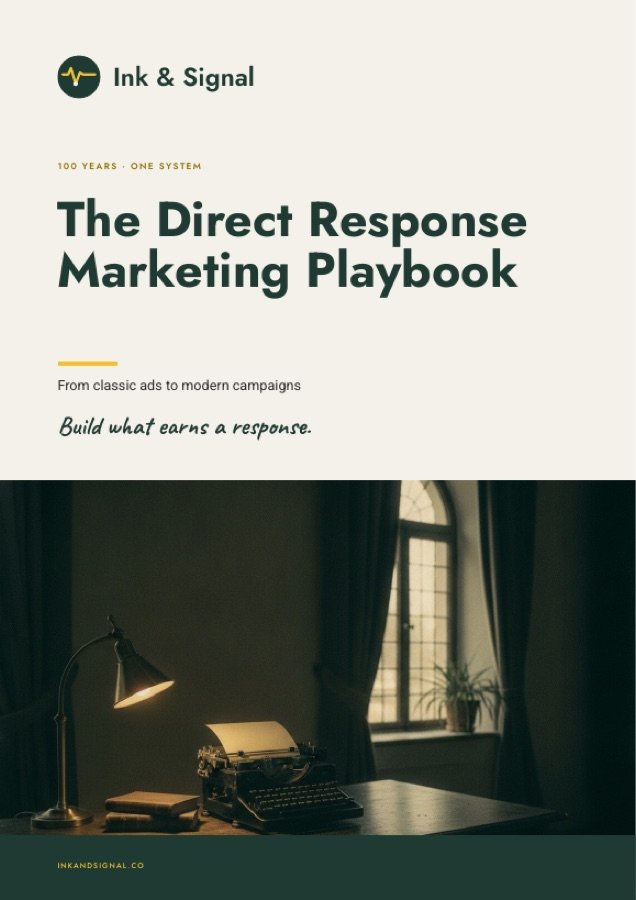
The playbook turns this into principle no. 3: treat every major claim as a testable hypothesis.
the limits
Where the book is dated
- The examples come from print and mail. Channels, costs and privacy rules have changed.
- A test needs enough responses to mean anything. Small numbers mislead.
- Counting the reply is easy in mail order and harder when a purchase takes weeks. Attribution needs care.
- Hopkins wrote for his own time. Read the method, and check each example against your market.
the full method
Hopkins is one of eight masters
Ink & Signal gives each master a page: the core idea, what to borrow today and the limit to respect. Hopkins’s is the experiment, and the other seven build on it.
the playbook
Get the playbook today.
One PDF, yours to keep. Read it on any screen or print the pages you want on the wall.
30-DAY
MONEY
BACK
$37
- The 48-page playbook (A4 PDF)
- 8 masters, 10 systems, 100 principles
- 30 worked example ads, with notes
- The 30-day build and stage tracker
- Bonuses worth $123: ReplaStats, a Blind Spot Audit and more
30-day money-back guarantee. If the book is not for you, write to hello@inkandsignal.co within 30 days and we refund you in full, and you keep the PDF.
before you go
Common questions
Who was Claude Hopkins?
An American advertising man who wrote Scientific Advertising (1923) and, a few years later, the memoir My Life in Advertising. He is the first of the eight masters in the Ink & Signal playbook.
What is Scientific Advertising about?
Treating advertising as something you can test. Hopkins argued that ads should be tried on a small scale, measured by the replies they bring, and judged by results rather than opinion.
When was Scientific Advertising published?
In 1923. It is a short book.
Is Scientific Advertising still worth reading?
Yes, for the method. The channels are old, but the habit of testing a claim and counting the response carries over to email, search and landing pages.
Where can I read it?
The book is from 1923, so it is in the public domain in the United States, and free copies exist. Look for a clean edition, because some scans are poor.
Is Scientific Advertising direct response?
It is the root of it. Hopkins learned from mail order, where every ad’s results can be counted, and he applied that discipline to advertising generally.
keep reading
Related
Breakthrough advertising
Eugene Schwartz on desire, awareness and market sophistication.
Copywriting examples
Eight before-and-after rewrites and why each one works.
Best copywriting books
The books behind the eight masters, in a reading order.