
THE SWIPE FILE GUIDE
Swipe file: what it is, what to save, and how to use it
Collect it. Annotate it. Write your own.
A swipe file is a collection of ads and copy that worked, kept so you can learn from them. This guide covers what to save, how to organize it, and how to use it without copying anyone.
Instant download · card or crypto · 30-day money-back guarantee
the idea
What a swipe file is
A swipe file is a collection of ads, emails, headlines, sales pages and offers that you save to study and to borrow structure from. Direct response writers have kept them for a long time, because a page that earned money teaches more than advice about it.
The point is to learn how a piece works: who it speaks to, what it promises, what proof it shows and what it asks the reader to do. You take the structure and the angle, and write your own words.
what to keep
What to save in a swipe file
| Save this | Why | Note beside it |
|---|---|---|
| Headlines and hooks | They show how a reader is stopped in a line. | Who it picks out, and what it promises. |
| Offers and guarantees | The offer often matters more than the copy around it. | What you get, for how much, and what the risk is. |
| Email subject lines | Short, and easy to compare. | The open and the reason you clicked. |
| Landing pages | They show a whole argument in order. | What comes first, where proof sits, and the one ask. |
| Ads you responded to | You are the best test case you have. | What made you act, in your words. |
| Direct mail and print | Space was expensive, so every line had a job. | The headline, the offer and the response device. |
Save the things that made you act. Your own clicks and purchases are the best evidence you have of what works on a real reader.
the method
How to build a swipe file in five steps
- Pick one home for it: a folder, a spreadsheet or a notes app. Two homes means neither gets used.
- Capture the piece, where you saw it and the date. Screenshots lose their context fast.
- Write one line on why it worked, or why you responded. Without the note you are keeping a scrapbook.
- Tag it by the job it does: headline, offer, proof, objection, close.
- Review it monthly, and write your own version of one piece each time.
reading one
How to read a piece from your swipe file
Run each saved piece through the same five questions. Writing the answers down is what turns a collection into a skill.
- Who is this written for, and how does the headline pick them out?
- What is the promise, and is it specific?
- What proof sits next to the claim?
- What is the offer, and what is the risk to the reader?
- What is the next step, and is it small enough to take now?
The questions come straight from the playbook’s principles, such as letting the headline select the right reader (no. 8), putting proof beside the claim it supports (no. 12) and making the next step unmistakable (no. 19).
what goes wrong
Four mistakes that make a swipe file useless
- Collecting with no notes. A folder of screenshots teaches nothing.
- Saving only famous ads. Your reader is not the Super Bowl audience.
- Copying the words. Another company’s copy can breach copyright, and it was written for their customers.
- Never opening it. Put a monthly review in your calendar.
already in order
A swipe file with the work done
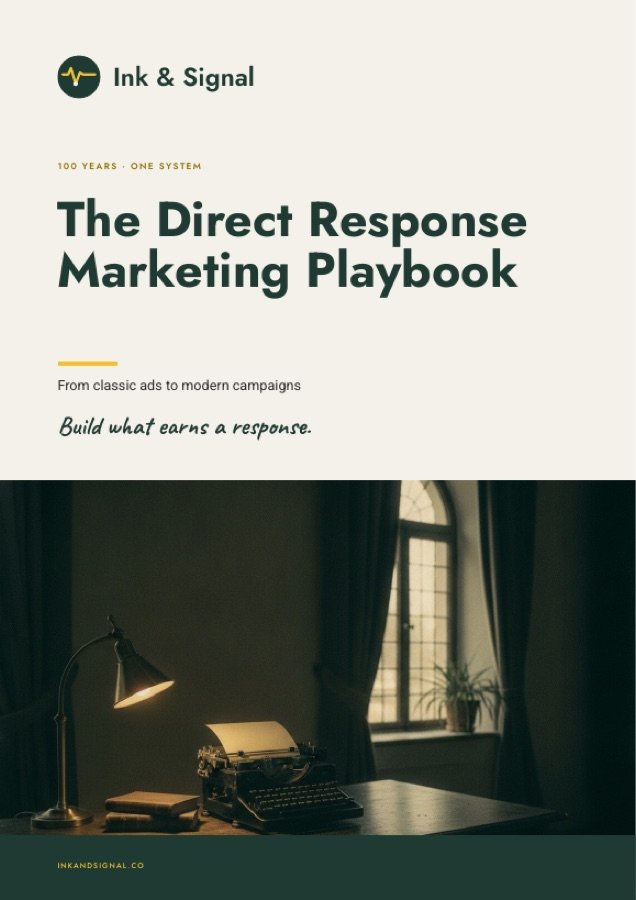
Ink & Signal is the swipe file organized into a method. 100 principles from 8 masters, 10 systems, and 30 modern example ads with notes, in 48 pages.
the playbook
Get the playbook today.
One PDF, yours to keep. Read it on any screen or print the pages you want on the wall.
30-DAY
MONEY
BACK
$37
- The 48-page playbook (A4 PDF)
- 8 masters, 10 systems, 100 principles
- 30 worked example ads, with notes
- The 30-day build and stage tracker
- Bonuses worth $123: ReplaStats, a Blind Spot Audit and more
30-day money-back guarantee. If the book is not for you, write to hello@inkandsignal.co within 30 days and we refund you in full, and you keep the PDF.
before you go
Common questions
What is a swipe file?
A collection of ads, emails, headlines, sales pages and offers that you save so you can study how they work and reuse their structure when you write your own.
What goes in a swipe file?
Anything that made you stop, click or buy: headlines, opening lines, offers, guarantees, email subject lines, landing pages, mailers and calls to action. Save each one with where you saw it and a line on why it worked.
Is using a swipe file plagiarism?
Studying examples is how writers learn. Copying another company’s words is the problem, and it can breach copyright. Borrow the structure and the idea, then write the words yourself.
How should I organize a swipe file?
Pick one home, such as a folder, a spreadsheet or a notes app. Tag each piece by the job it does, such as headline, offer, proof or close, and add a one-line note on why it worked.
How many examples do I need?
Fifty well-annotated pieces beat five hundred loose screenshots. Start with the ten that made you act, and add a few each week.
keep reading
Related
Copywriting examples
Eight before-and-after rewrites and why each one works.
What is direct response marketing?
A plain definition, with examples and the numbers to track.
Headlines that attract the right customers
One principle from the book, applied to real ads.