

Curiosity headlines that convert do what clickbait never does: they tie the open question to something the reader already wants or fears losing. Curiosity alone earns a click. Curiosity attached to meaningful self-interest earns a read, and then a response. That is principle 9 of the Ink & Signal field principles.
TL;DR:
- Curiosity opens the door, but self-interest is what makes a reader walk through it and act.
- Principle 9: "Attach curiosity to meaningful self-interest." A gap with no stake is only a riddle.
- The classic masters treated curiosity as a seasoning for a real benefit.
- The mistake that breaks it is a gap the body never closes, or one about something the reader doesn't care about.
- Write the payoff sentence first, then the headline. If the payoff is weak, the headline overpromises.
Table of Contents
- Why Curiosity Headlines That Convert Need a Stake as Well as a Gap
- Principle 9 in Plain Words: Curiosity Is the Hook, Self-Interest Is the Weight
- Why It Holds: The Information Gap Has a Price of Admission
- Where the Classic Masters Agree, and Where You Should Part Ways
- A Worked Example: Rewriting an Email Subject Line for an Invoicing App
- The Mistake That Breaks It: A Gap the Body Never Closes
- A Checklist for Applying Principle 9 This Week
- Get All 100 Field Principles, Not Just Number 9
- Frequently Asked Questions
- Sources
Why Curiosity Headlines That Convert Need a Stake as Well as a Gap
A note for anyone who arrived expecting a unit calculator or a file converter: wrong door, right word. "Convert" here means a reader becoming a subscriber, a lead or a buyer.
Most advice on curiosity headlines stops at the gap: hint at something, withhold the rest, collect the click. That is half a headline. The click is cheap. What you are paid for is the next action, and a reader takes that action only if the answer matters to them.
Think of two headlines. "The strange thing about Tuesdays" opens a gap. "The one day of the week your emails get ignored" opens the same gap and puts the reader's own results on the table. The second one has a stake. The first has only a mystery.
Principle 9 in Plain Words: Curiosity Is the Hook, Self-Interest Is the Weight
The principle reads, word for word: "Attach curiosity to meaningful self-interest." Each word does work.
- Attach. Curiosity and self-interest have to be fused in the same line. A curious headline followed by a benefit three paragraphs later has already lost the scroll.
- Meaningful. The self-interest must be something the reader would pay, worry or hurry over. "Interesting" is not meaningful. "Costs you money" is.
- Self-interest. The reader's gain or loss, not yours. Your launch, your milestone and your clever new feature are not stakes.
A curiosity gap with no stake is a riddle. A stake with no gap is a feature list. You need both in one line.
If you already segment readers by how much they know, this pairs well with Eugene Schwartz's five stages of awareness. The stake you name should match what the reader already knows they want.
Why It Holds: The Information Gap Has a Price of Admission

The best-documented explanation comes from economist George Loewenstein. His 1994 review, "The Psychology of Curiosity" in Psychological Bulletin, frames curiosity as the feeling of a gap between what you know and what you want to know. The gap has to matter to the person, which is the whole point of principle 9. A gap about something you have no stake in produces a shrug.
Direct-response practice reached the same conclusion without the lab. John Caples, in Tested Advertising Methods, sorted effective headlines into broad appeals: self-interest, news and curiosity. In the spirit of his advice, curiosity works best when it rides on the other two. His famous piano ad for a music school, "They Laughed When I Sat Down at the Piano, But When I Started to Play!", is a gap with a human stake inside it: status, skill and the satisfaction of being proved wrong about you.
Where the Classic Masters Agree, and Where You Should Part Ways
The old guard is useful here, with limits.
- Caples. Pairs curiosity with a reader benefit, and he learned it from tests. Follow him.
- Claude Hopkins. In the spirit of Scientific Advertising, advertising is salesmanship, not entertainment. A clever line that doesn't sell is decoration. Follow him on the standard, and skip the era's media.
- David Ogilvy. Famous for the long, specific, newsy headline. His preference for substance over cleverness supports the stake rule, though he wrote for print, where a reader chose to look at the page. You write for an inbox or feed where a reader chooses to ignore it.
Here is how the three headline types compare in practice.
| Headline type | Example | What it earns | Typical failure |
|---|---|---|---|
| Curiosity only | "You won't believe what we built" | A click from the idly curious | Bounce when the body has no stake |
| Self-interest only | "Get paid faster with invoice reminders" | A read from people already shopping | Gets lost among a hundred identical promises |
| Curiosity plus stake | "The line on your invoice that lets clients pay late" | A click and a reason to keep reading | Fails only if the payoff is weak |
Self-interest alone is not a bad choice. For readers already hunting a solution, I would pick plain benefit over a teaser every time. Curiosity earns its place when the reader isn't looking, when your promise sounds like everyone else's, or when the mechanism is the interesting part. For that last case, see unique mechanism in marketing.
A Worked Example: Rewriting an Email Subject Line for an Invoicing App

The following is a composite built to show the mechanics. It is not a real client and it reports no results.
Picture a small invoicing app for freelancers, sending a launch email for a feature that sets exact due dates on invoices.
Version one (curiosity only): "Our most surprising feature yet." The gap is real, but the reader has no idea what is at stake. It is about the company, not the reader.
Version two (self-interest only): "New: set due dates on invoices." It is clear and honest, and also what every competitor's changelog says.
Version three (curiosity plus stake): "The line on your invoice that tells clients they can pay late."
Version three works because the stake is the reader's own cash flow, and the gap is concrete: which line? The body must then pay off in its first sentence. Something like: "It's usually 'due upon receipt.' With no date attached, the client sets their own deadline, and it is rarely the one you wanted." The email then shows the fix, a specific date on every invoice, and offers the feature.
The payoff is plain, useful on its own, and a little embarrassing to the reader, in a good way. That is sell the outcome, not the product in practice: the headline sells getting paid on time, and the feature is merely the vehicle.
The payoff should land in the first sentence after the headline, not the fourth paragraph.
The Mistake That Breaks It: A Gap the Body Never Closes

The usual failure is a headline that borrows attention and doesn't pay it back. It comes in three versions.
- The empty gap. The headline promises a secret and the body delivers a sales pitch. Readers feel cheated, and they remember.
- The wrong stake. The curiosity is about something the reader has no reason to care about, such as your company news or an obscure statistic, so the click never turns into a read.
- The exaggerated gap. The headline implies more than the offer delivers. Beyond lost trust, this can create legal exposure. The U.S. Federal Trade Commission's advertising and marketing guidance says ads must be truthful and not misleading, and its test looks at the net impression on a reasonable consumer, not at your intent. A teaser that implies a claim the body can't back is on the wrong side of that test.
Specific claims also protect you. If the teaser points at something real, such as one named line on an invoice, you can prove it. See specificity in copywriting for why proof beats hype, and testing marketing claims for how to confirm that the claim holds before you test whether it sells.
The deletion test: Write the payoff sentence before you write the headline. Then cut the curiosity half of the headline: if what remains still gives a reader a reason to care, you have a real stake. Cut the stake half: if what remains is a bare riddle, the stake is carrying the weight. A headline that fails the first cut has no meaningful self-interest, however clever it sounds.
A Checklist for Applying Principle 9 This Week
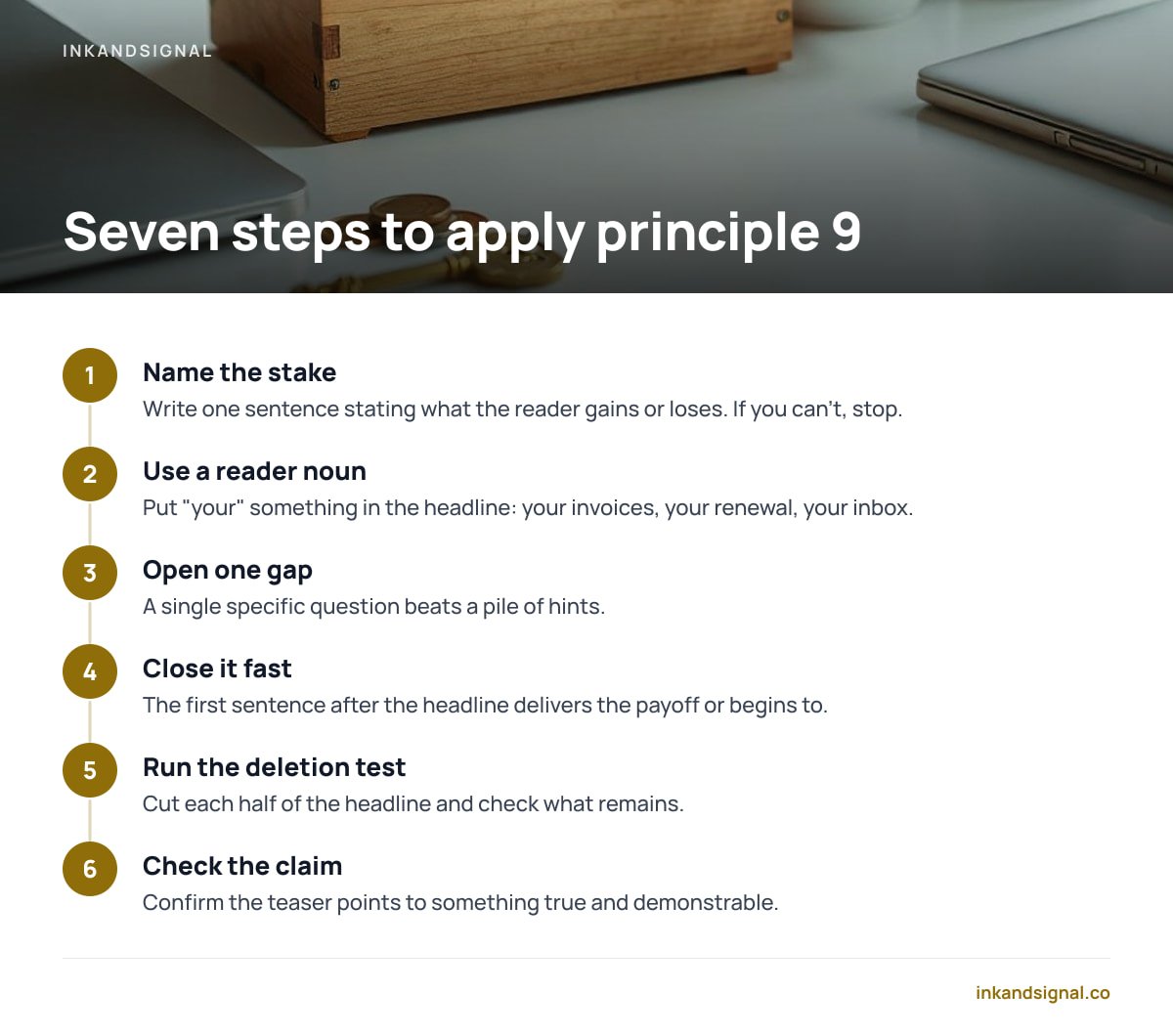
Take one live asset: an email, a landing page headline or an ad. Then work through these steps.
- Name the stake. Write one sentence stating what the reader gains or loses. If you can't, stop. The problem is upstream of the headline.
- Use a reader noun. Put "your" something in the headline: your invoices, your renewal, your inbox. It is the cheapest stake there is.
- Open one gap, not three. A single specific question beats a pile of hints.
- Close it fast. The first sentence after the headline delivers the payoff or begins to.
- Run the deletion test from the tip above.
- Check the claim. Confirm that the teaser points to something true and demonstrable.
- Split test two versions. Compare the curiosity-plus-stake version against a plain-benefit version. Measure the downstream action, not just the open or click.
That last step matters, because a headline can win the click and still lose the sale.
Get All 100 Field Principles, Not Just Number 9
Principle 9 is one of 100 in The Direct Response Marketing Playbook from Inkandsignal, a 48-page PDF for $37. It condenses a century of direct-response advertising into 8 masters, 10 systems, 100 principles, 30 example ads and a 30-day campaign build. If you tend to stall at the blank-headline stage, the principles checklist and the example ads give you something concrete to measure your drafts against. A free principle card deck sample lets you test the style before you spend anything.
The caveat: it is a book of methods, so it will not write your copy, and it can't promise your results, because those depend on your offer and your audience. Check the product page for the exact contents before you buy, and treat every principle, including this one, as a hypothesis to test.
Frequently Asked Questions
Are curiosity headlines the same as clickbait?
No. Clickbait opens a gap and doesn't close it, or exaggerates what is behind it. A curiosity headline that converts points at something real and specific, attaches it to the reader's own interest, and pays it off in the first lines of the body.
When should I skip curiosity and use a plain benefit headline?
When the reader is already actively searching for a solution, a clear statement of the benefit usually serves them better. Curiosity helps most when the reader isn't looking, when your promise sounds like everyone else's, or when the mechanism behind the result is the interesting part. Test both against each other to find out for your audience.
What counts as "meaningful" self-interest?
Something the reader would spend money, time or worry on: income, savings, status, safety, time back, or avoiding an embarrassing mistake. If the stake would not make the reader change a plan or open their wallet, it is probably only interesting.
How do I measure whether a curiosity headline converts?
Track the action you actually want, such as a signup, purchase or reply, and not only opens or clicks. A headline can win the click and lose the sale, so compare versions on the downstream result, with enough traffic to trust the difference.
Do curiosity headlines work in every channel?
The principle holds across channels, but the execution varies. Inbox previews and ad feeds truncate text, so the stake should appear early in the line. Search ads and pages that match a specific query often reward clearer benefit-led wording.
Sources
- The Psychology of Curiosity: A Review and Reinterpretation | George Loewenstein, Psychological Bulletin (hosted by Carnegie Mellon University)
- John Caples | Wikipedia
- Advertising and Marketing | U.S. Federal Trade Commission
Leave a Reply