

Specificity in copywriting means replacing claims a reader has to take on faith with details they can picture, check, or test: a number, a name, a mechanism, a deadline. The split that matters is supported versus unsupported, not specific versus vague. "Fastest delivery" is hype. "Ships in 48 hours from Ohio" is a promise someone can hold you to, and that accountability is why readers believe it.
TL;DR:
- Specific copy works because readers discount superlatives before they finish reading them, and a checkable detail survives that discount.
- The fast test is portability. If a competitor could paste your sentence onto their page unchanged, it is hype.
- Puffery is legally safer than specifics, because objective claims need evidence under both FTC guidance and the UK CAP Code. Do the proof work anyway.
- The common failure is fake precision, or precision about the wrong thing. Be specific about the doubt your buyer actually has.
- This week, rewrite one headline, one subject line, and one offer using a number, a mechanism, or a named outcome you can prove.
Table of Contents
- What Specificity in Copywriting Means, and What It Doesn't
- Why Specific Claims Outsell Big Ones: The Three Mechanisms
- A Worked Example: Rewriting an Invoicing App's Landing Page
- The Trade-Off Nobody Mentions: Hype Is Legal, Specifics Need Proof
- The Common Mistake: Being Precise About the Wrong Thing
- What "Precision in Writing" Means, and How to Build the Skill
- Is Copywriting Still Worth It in 2026, and Can It Pay $5,000 a Month?
- Your Specificity Checklist for This Week
- Get 100 Principles You Can Test, Not Just Admire
- Frequently Asked Questions
- Sources
What Specificity in Copywriting Means, and What It Doesn't
Principle 5 of the 100 field principles in this series reads, in full: "Specificity beats unsupported hype." Two words in it carry the weight. "Specificity" means a detail the reader can picture or verify, such as a figure, a timeframe, a named ingredient, a named customer, or a mechanism. "Unsupported" means the claim arrives with nothing behind it: no number, no proof, and no reason to believe it.
Enthusiasm still has a place, and not every sentence needs a statistic. A headline can be bold as long as it is bold about something the reader can check. "The best invoicing app for freelancers" is loud and empty. "Get paid an average of 11 days sooner" is just as confident, and it gives a reader something to test, provided the number is real.
The quickest diagnostic is portability. Ask whether a competitor could paste your sentence onto their own site without changing a word. "Quality you can trust" fits on anyone's homepage. "Every board is kiln-dried before we cut it, so your table won't warp in its first winter" belongs to one workshop. If your line is portable, it is hype, however well it scans.
Why Specific Claims Outsell Big Ones: The Three Mechanisms

Claude Hopkins made this case in Scientific Advertising (1923), in a chapter titled "Being Specific." His most quoted line from it is "Platitudes and generalities roll off the human understanding like water from a duck. They leave no impression whatever." His argument was that readers expect sellers to exaggerate and mark down superlatives as soon as they hear them. A definite statement escapes that markdown because it sounds like a fact, not a boast.
Hopkins's best-known demonstration, recounted in his memoir My Life in Advertising, was for Schlitz beer. Every brewer was then shouting "pure." Hopkins toured the brewery and wrote about what he saw: beer cooled in rooms of filtered air, bottles washed with live steam, and water drawn from deep artesian wells. Rival brewers did much the same. None of them had said it. The brand that described its process in detail took the claim that everyone else had only asserted.
Specifics signal that you know the subject
A vague claim could come from anyone. A detail like "machined to 0.01 mm tolerance" or "reminder emails go out on day 7, 14 and 30" implies that the writer has been inside the product. Readers treat that knowledge as evidence of competence, often before they have checked a single fact.
Specifics are falsifiable, so they borrow credibility
A specific claim can be shown to be wrong. That risk is the source of its power. Readers reason, mostly without noticing, that nobody would print something checkable unless it were true. "Best" carries no risk, so it earns no trust.
Specifics give the brain something to hold
Abstract nouns slide past. Concrete images stick. Nielsen Norman Group tested this on the web in its study of how users read online, comparing a promotional version of a page against one written in neutral, objective language.
Removing promotional language alone improved measured usability by 27% in Nielsen Norman Group's study, and that was before a single new fact was added.
A Worked Example: Rewriting an Invoicing App's Landing Page
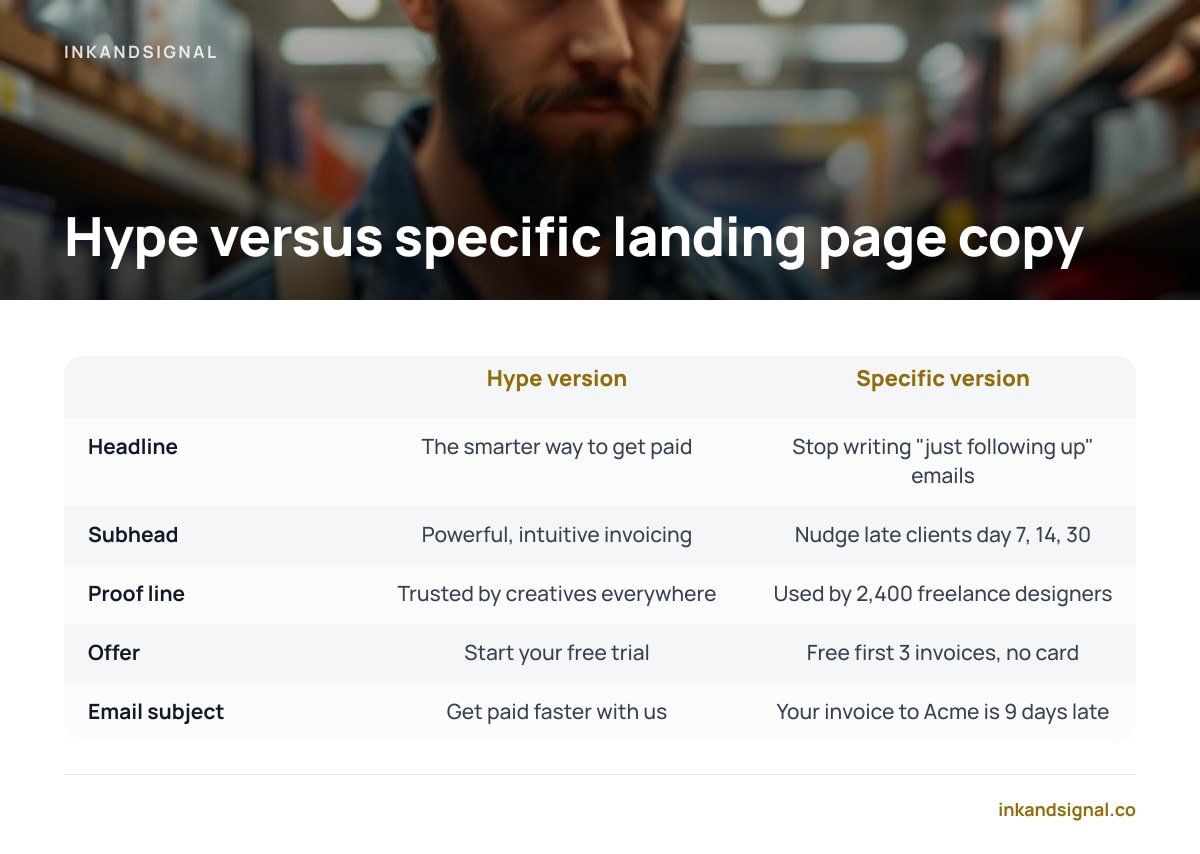
Take a hypothetical but entirely typical small SaaS product: an invoicing tool for freelance designers. The current hero section reads "The smarter way to get paid. Powerful, intuitive invoicing that saves you hours." Every word of it is portable. A payroll app, a bank, or a spreadsheet template could use it unchanged.
The rewrite starts with a question: what does a freelancer actually dread? Not the invoicing itself. It is chasing a client who is 30 days late, and the awkward email that comes with it. So the specifics should go there.
| Element | Hype version | Specific version | What it must be backed by |
|---|---|---|---|
| Headline | The smarter way to get paid | Stop writing "just following up" emails | Automated reminders that actually exist |
| Subhead | Powerful, intuitive invoicing | We nudge late clients on day 7, 14 and 30, from your own email address | The real reminder schedule in the product |
| Proof line | Trusted by creatives everywhere | Used by 2,400 freelance designers (example figure) | A live, current customer count |
| Offer | Start your free trial | Free for your first 3 invoices. No card needed | Billing logic that matches the promise |
| Email subject | Get paid faster with us | Your invoice to Acme is 9 days late | A trigger tied to real invoice data |
Look at the subject line in the last row. It names the client, the number of days late, and the problem, and it takes no effort to read. The hype version asks the reader to believe something. The specific version tells them something they need to know right now.
Pro Tip: Write the specific version first, then check whether you can prove it. If you can't, the fix is almost never a softer adjective. It is usually a change to the product or the offer. If you can't honestly write "reminders on day 7, 14 and 30," build the reminders. Copy that exposes a gap in the product is doing its job.
The Trade-Off Nobody Mentions: Hype Is Legal, Specifics Need Proof

The competing articles skip one fact: vague copy is the legally safer choice. The UK's CAP Code allows "obvious exaggerations ('puffery')" that the average consumer is unlikely to take literally. It then requires marketers to hold documentary evidence for any claim consumers are likely to regard as objective.
Under rule 3.7 of the UK CAP Code, you must hold documentary evidence before publishing any claim a consumer would read as objective. "Best coffee in town" needs none. "Roasted 48 hours before it ships" does.
The US position runs along the same line. The Federal Trade Commission's advertising guide for small businesses states that advertisers must have evidence to back up their claims. The FTC's broader advertising and marketing guidance makes clear that the claim the regulator cares about is the one a reasonable consumer takes away, not the one you meant.
So the answer that looks obvious, "add numbers and you'll be more persuasive," is incomplete. Numbers add persuasion and liability together. Copy that is safest in legal terms is also the copy that sells least. Take the specificity and do the proof work. Keep the evidence file before launch, not after a complaint. The method for that is in testing marketing claims: prove it's true, then prove it sells.
The Common Mistake: Being Precise About the Wrong Thing
Most copy that fails this principle is specific in a way that misses the point.
- Fake precision. "Boosts productivity by 43.7%" with no source reads as invented, because it usually is. An unrounded number only helps when the real figure happens to be unrounded. Don't manufacture decimals.
- The spec dump. "8-core processor, 16 GB RAM, 1 TB SSD" is specific, but it is specific to the engineer. The buyer's question is "Will it export my 4K video without freezing?" Translate the spec into the outcome it delivers.
- Specific about yourself, vague about them. "Founded in 2009, 14 staff, three offices" answers questions nobody asked. Point your specifics at the doubt that stops the purchase: price, risk, effort, time to result. The quickest way to find that doubt is in the customer's own words, which is why voice of customer copywriting comes before the draft.
- Stacking every detail. Ten specifics in one paragraph turn into noise. Use one sharp detail per claim and let it carry the weight.
What "Precision in Writing" Means, and How to Build the Skill

Precision in writing means using the exact word, figure, or example that fits the claim, so the reader cannot take away a wider or vaguer meaning than you intended. "Soon" is imprecise. "By Thursday" is precise. In copy, precision is how specificity shows up at the level of the sentence: one meaning, stated once, with nothing to interpret.
The skill builds through repetition on real material. This is the routine we would pick over any course:
- Hand-copy one proven ad a day. Writing out long-form direct-response ads by hand slows you down enough to notice where the specifics sit and what they replace.
- Rewrite one live piece of copy a day. Take a headline from your own site or inbox. Remove every adjective, then put back only the details you can prove.
- Interview one customer a week. Most generic copy comes from writers who have never heard a buyer describe the problem. Specific phrases come from people, not from thesauruses.
- Ship a test every week. A rewrite that never meets an audience teaches you nothing. Split-test a subject line. It is the cheapest experiment in marketing.
Is Copywriting Still Worth It in 2026, and Can It Pay $5,000 a Month?
Copywriting is still worth learning in 2026, though it is a different skill from five years ago. Generic, competent-sounding text now costs almost nothing to produce, so it is worth almost nothing. What stays scarce is copy grounded in specific knowledge of a product, a market, and a customer's exact objection. That is this article's principle applied to the career itself: the portable writer gets replaced, and the specific one gets hired.
Earning $5,000 a month from copywriting is realistic for some writers. It isn't a default outcome, and no honest source can promise it. The arithmetic is simple. Five retainer clients at $1,000 a month gets you there, and so do two launch projects at $2,500. What separates writers who reach that figure from those who don't is usually niche and proof, not talent. "I write email sequences for Shopify skincare brands, and here are three results with numbers" wins briefs that "I'm a versatile copywriter" never sees. Before you pitch, it helps to know how to find a hungry market, for your services as much as for your clients' products.
Your Specificity Checklist for This Week
Run each item against one real asset you already have live:
- Run the portability test on your headline. If a competitor could use it word for word, rewrite it around one detail only you can claim.
- Name the doubt. Write down the single objection that stops your buyer. Make sure your most specific line answers that objection and not some other one.
- Replace one adjective with one number. "Fast" becomes a time. "Affordable" becomes a price or a cost per use. "Popular" becomes a count you can verify.
- Build the evidence file. For every objective claim, save the source (dashboard screenshot, test result, invoice data) before the copy goes live.
- Test one subject line. Send the hype version and the specific version to two halves of a list. Let the response decide, not your taste.
Get 100 Principles You Can Test, Not Just Admire
If this checklist felt useful, the full system works the same way across the whole campaign. Inkandsignal publishes The Direct Response Marketing Playbook, a 48-page PDF for $37. It condenses eight direct-response masters into 10 systems and 100 principles like this one, with 30 example ads showing specificity, offers, and proof at work, and a 30-day, eight-stage campaign build that turns the principles into something you ship.
One limit: it is a playbook, not a done-for-you service. It will show you how to rewrite "the smarter way to get paid" into a line that sells. It cannot supply the proof behind your claims, and it cannot run your tests for you. If you want to try the method before buying, start with the free principle card deck sample on the Ink & Signal site.
Frequently Asked Questions
What is specificity in copywriting?
Specificity in copywriting is the practice of replacing vague or superlative claims with concrete details a reader can picture or verify, such as numbers, timeframes, mechanisms, or named outcomes. It works because readers discount generic boasts but tend to accept definite, checkable statements. The detail has to be true and provable for the effect to hold.
Why does specific copy convert better than hype?
Specific claims can be shown to be wrong, so readers assume a seller would not print one unless it were true. Concrete details also show knowledge of the product and are easier to remember than abstract praise. Superlatives like "best" or "powerful" carry no risk for the seller, so they earn little trust.
Can copy be too specific?
Yes, when the details answer questions the buyer never asked or pile up into noise. A list of technical specs or company history is specific but often irrelevant to the purchase decision. Aim for one sharp detail per claim, pointed at the objection that actually stops the sale.
Do specific advertising claims need proof?
Generally, yes. In the US, the FTC says advertisers must have evidence to back up their claims. In the UK, the CAP Code requires documentary evidence for claims consumers are likely to see as objective. Obvious puffery gets more latitude, which is why vague copy is legally safer but usually less persuasive.
How do I make a vague headline more specific?
Start by naming the single doubt or pain your buyer has, then replace every adjective with a detail that addresses it, such as a time, a price, a count, or a mechanism. Check whether a competitor could use the line unchanged. If they could, keep revising until the sentence could only describe your offer.
Sources
- How Users Read on the Web | Nielsen Norman Group
- UK Code of Non-broadcast Advertising and Direct & Promotional Marketing (CAP Code) | Advertising Standards Authority
- Advertising FAQ's: A Guide for Small Business | Federal Trade Commission
- Advertising and Marketing | Federal Trade Commission
Leave a Reply