
THE MASTERS · SUGARMAN
Joe Sugarman: the slippery slide and what to use
Create momentum one sentence at a time.
Joe Sugarman sold products through ads and wrote about how a reader moves through copy. This page covers his background, six ideas worth keeping, how to use them on a page and where they need care.
Instant download · card or crypto · 30-day money-back guarantee
who he was
About Joe Sugarman
Joe Sugarman is an American direct marketer and copywriter. He ran JS&A, a company that sold products through magazine and mail-order ads, and he later wrote about how those ads worked.
His best-known book on copywriting is The Adweek Copywriting Handbook. He is remembered for the slippery slide and for his attention to how a reader moves through a page.
six ideas
Six ideas that still hold
| Idea | What it says | How to use it now |
|---|---|---|
| The slippery slide | Every sentence exists to get the next one read. | Read your draft aloud and cut any sentence that gives the reader a reason to stop. |
| The first sentence | It must be short and easy, so the reader starts. | Open with a short line that links to the headline. See headline examples. |
| Seeds of curiosity | Short lines that promise the next point. | Use them sparingly, and pay each one off. See curiosity headlines that convert. |
| Psychological triggers | People respond to a set of known motives, such as curiosity and consistency. | Check which motive your ad uses, and whether the proof supports it. |
| Copy is a conversation | The reader should feel the writer is talking to them. | Write as if to one person, with plain words. |
| Every element has a job | The headline, the picture and the layout all help the reader move down. | Remove any element that does not help the reader reach the next one. |
in practice
Using Sugarman on a page
- Write a headline that picks the reader, then a first line short enough to read at a glance.
- Give each paragraph one job and end it with a reason to read the next.
- Use one seed of curiosity per section, and pay it off within a paragraph or two.
- Read the page aloud and mark every place you would stop reading. Fix those first.
the limits
Where Sugarman needs care
- His work comes from print ads and catalogs. Web pages scroll differently.
- Triggers can push a reader too hard, so check that each claim has proof.
- Long copy suits a considered purchase. Test the length in your market.
- Take the momentum from one sentence to the next, and test the style.
reading him
Where to start reading
The Adweek Copywriting Handbook is the usual starting point. The best copywriting books page puts it in a reading order with the other masters.
the full method
Sugarman is one of eight masters
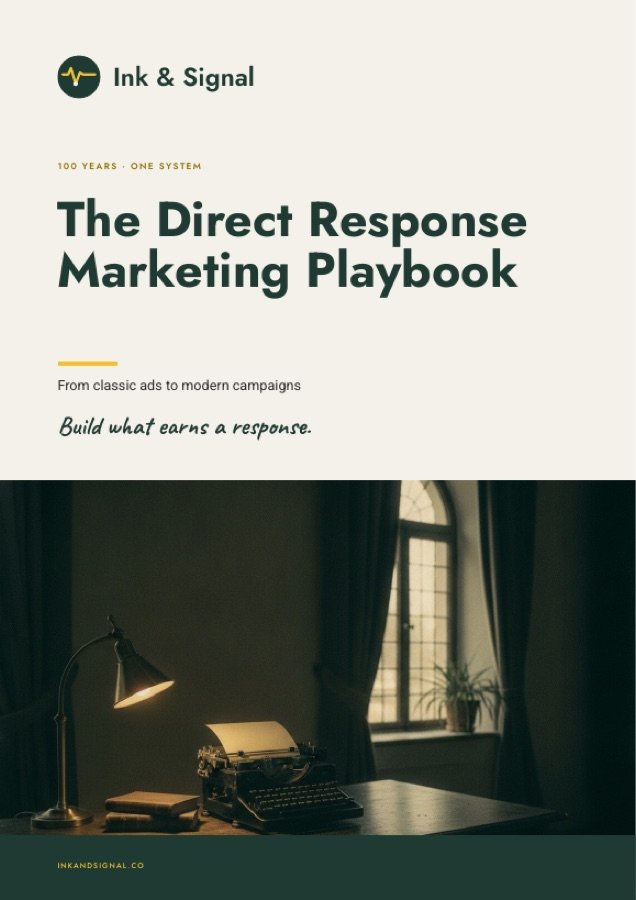
In the playbook his page covers the core idea, what to borrow today and the limit to respect. His line is create momentum one sentence at a time.
the playbook
Get the playbook today.
One PDF, yours to keep. Read it on any screen or print the pages you want on the wall.
30-DAY
MONEY
BACK
$37
- The 48-page playbook (A4 PDF)
- 8 masters, 10 systems, 100 principles
- 30 worked example ads, with notes
- The 30-day build and stage tracker
- Bonuses worth $123: ReplaStats, a Blind Spot Audit and more
30-day money-back guarantee. If the book is not for you, write to hello@inkandsignal.co within 30 days and we refund you in full, and you keep the PDF.
before you go
Common questions
Who is Joe Sugarman?
An American direct marketer and copywriter who ran JS&A, a company that sold products through magazine and mail-order ads. He wrote The Adweek Copywriting Handbook.
What is the slippery slide?
Sugarman’s image for copy that pulls the reader down the page. Each sentence has one job, which is to get the next sentence read.
What are seeds of curiosity?
Short teasing lines, often at the end of a paragraph, that make the reader want the next one. They keep the reader moving.
What are Sugarman’s psychological triggers?
A set of reasons people respond to an ad, such as curiosity and the wish to be consistent. He describes them in his copywriting books.
What is the Adweek Copywriting Handbook?
Sugarman’s book on writing copy, covering how an ad is built and why readers respond.
Where does Sugarman fit in Ink & Signal?
He is one of the eight masters, with the line create momentum one sentence at a time.
keep reading
Related
Curiosity headlines that convert
Attach the gap to a stake.
Headline examples
Ten types of headline, each with a rewrite.
Best copywriting books
The books behind the eight masters, in a reading order.