
DIRECT RESPONSE COPYWRITING
Direct response copywriting: what it is and how to write it
Say who it is for. Make one offer. Ask for one step.
Direct response copywriting is writing built to get one measurable action. This guide covers the seven parts of a piece, a five-step process, how it changes by channel and the mistakes that cost the most.
Instant download · card or crypto · 30-day money-back guarantee
the definition
What direct response copywriting is
Direct response copywriting is writing that asks the reader to do one specific thing and is judged by how many did. The thing might be a purchase, a call, a sign-up or a quote request.
A line stays only if it earns replies. The habit comes from mail order, where Claude Hopkins and John Caples counted the replies to every ad they ran. It is the writing half of direct response marketing.
the parts
The seven parts of a direct response piece
| Part | Its job | A question to ask |
|---|---|---|
| Headline | Picks out the right reader and earns the next line | Who is this for, and what does it promise them? |
| Lead | Carries the reader from the headline into the piece | Does it open on a situation the reader is living? |
| Promise | States the one thing the reader gets | Can I say it in one sentence, with a number or a detail? |
| Proof | Makes the promise believable | Does each claim have evidence beside it? |
| Offer | Says what they get, for how much and on what terms | Would I take this offer if the copy were plain? |
| Risk reversal | Lowers the cost of being wrong | Can the buyer check the guarantee? |
| Next step | Tells the reader exactly what to do | Is it one action, small enough to take now? |
The playbook turns these into principles: the headline selects the reader (no. 8), proof sits beside the claim (no. 12), the offer is strengthened before the copy is decorated (no. 16) and the next step is unmistakable (no. 19).
the process
A five-step process
- Choose the reader and the one action you want. If you cannot name both, stop here.
- Collect the reader’s own words from reviews, emails, sales calls and chats, and note the phrases they repeat. Voice of customer copywriting covers this step.
- Decide the offer before you write the copy. A stronger offer often lifts a weak page more than better sentences do.
- Write the headline, then nine more. Keep the best two for testing.
- Draft the piece in the order of the seven parts, then cut every line that does not help the reader reach the next step.
Then run it live as a test. Keep the version that earns more replies and write the next challenger.
by channel
How the copy changes by channel
| Channel | What the copy must do | Watch out for |
|---|---|---|
| Landing page | Repeat the ad’s promise, show proof, ask once | Several competing buttons |
| Win the open with the subject line, then send the reader to one page | Writing for the inbox and forgetting the page | |
| Search ad | Match the query, then promise what the page delivers | Claims the page does not back up |
| Paid social | Stop a scroller with a situation they recognize | Hype with no proof |
| Direct mail | Get the envelope opened, then keep the letter read | Looking like advertising |
Whatever the channel, the ad and the page must make the same promise. Ad to landing page message match shows what a break looks like (no. 10).
what goes wrong
Five mistakes that cost the most
- Writing for everyone. A headline that tries to fit every reader picks out none. See headlines that attract the right customers.
- Selling features. Readers buy the result, so sell the destination, not the vehicle. See sell the outcome.
- Claims with no proof. “Trusted by thousands” gives the reader nothing to check. A count, a date and a source do.
- Several asks on one page. Each extra button splits the replies.
- Never testing. A line that sounds good in the meeting can lose to a plain one in the market. See testing marketing claims.
getting good
How to get good at it
- Read the masters. The best copywriting books page has a reading order.
- Keep a swipe file, with a line on why each piece worked.
- Rewrite what you meet. The copywriting examples page shows eight before-and-after rewrites.
- Test your own copy against a control, and keep the result.
the full method
Eight masters, ten systems, 100 principles
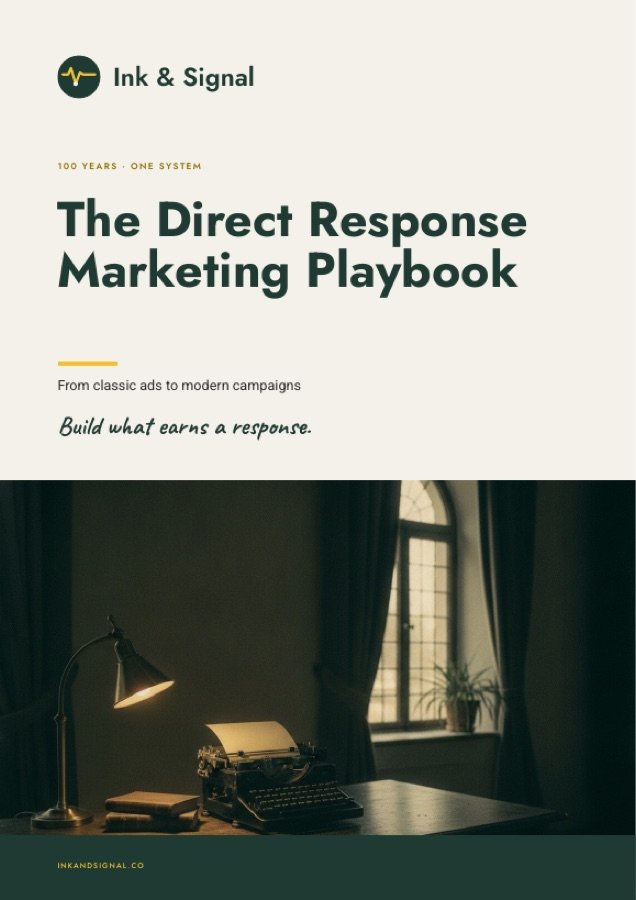
Ink & Signal puts the method in 48 pages, from Hopkins to Kennedy, translated into landing pages, email, paid social and search, with 30 modern example ads.
the playbook
Get the playbook today.
One PDF, yours to keep. Read it on any screen or print the pages you want on the wall.
30-DAY
MONEY
BACK
$37
- The 48-page playbook (A4 PDF)
- 8 masters, 10 systems, 100 principles
- 30 worked example ads, with notes
- The 30-day build and stage tracker
- Bonuses worth $123: ReplaStats, a Blind Spot Audit and more
30-day money-back guarantee. If the book is not for you, write to hello@inkandsignal.co within 30 days and we refund you in full, and you keep the PDF.
before you go
Common questions
What is direct response copywriting?
Writing that asks the reader to take one specific, measurable action now, such as buy, call, subscribe or request a quote. Every line is judged by whether it moves the reader toward that action.
How is it different from brand copywriting?
Brand copy builds recognition and a feeling over a long time. Direct response copy makes a specific offer and counts the replies, so you learn within days whether a line worked.
What are the parts of a direct response piece?
A headline that picks the reader, a lead, a promise, proof, an offer, a way to reduce risk and a clear next step.
How do I learn direct response copywriting?
Read the old masters, keep a swipe file, rewrite the ads you meet against a checklist, and test your own copy against a control. Start with Scientific Advertising, which is short.
Does it work for email and landing pages?
Yes. Email, landing pages, search ads, paid social and direct mail all suit it, because each one lets you count clicks and sales.
How long should direct response copy be?
As long as it takes to answer the reader’s questions, and no longer. A cold reader weighing an expensive offer needs more than a warm reader of a cheap one.
keep reading
Related
Headline examples
Ten types of headline, each with a rewrite.
Copywriting examples
Eight before-and-after rewrites and why each one works.
Best copywriting books
The books behind the eight masters, in a reading order.