
THE MASTERS · OGILVY
David Ogilvy: who he was and what to take from him
Research before decoration.
David Ogilvy (1911 to 1999) built an agency on research and a clear promise. This page covers who he was, six ideas worth keeping, how to use them in a small business and where they need care.
Instant download · card or crypto · 30-day money-back guarantee
who he was
Who David Ogilvy was
David Ogilvy was born in England in 1911 and died in 1999. Before advertising he worked as a researcher and as a salesman, and he carried both habits into the agency he founded in 1948, which became Ogilvy & Mather.
He is known for campaigns for Rolls-Royce and Hathaway shirts, and for two books, Confessions of an Advertising Man and Ogilvy on Advertising. He also said that nobody should work in advertising until they had read Scientific Advertising seven times.
six ideas
Six ideas that still hold
| Idea | What it says | How to use it now |
|---|---|---|
| Research first | Ogilvy began as a researcher and wanted facts about the product and the buyer before any idea. | Read reviews, talk to customers and check what competitors say before you write. |
| The headline carries the ad | He wrote that five times as many people read the headline as the body copy. | Give the headline the most time. See headline examples. |
| Facts beat adjectives | His Rolls-Royce ad rested on one concrete fact about the clock. | Swap praise for a number or a detail. See specificity in copywriting. |
| Long copy can sell | He argued that a reader who wants facts will read a lot of them. | For a considered purchase, give the reader the information they need to decide. |
| Judge by results | He treated direct marketing as a discipline that counts replies. | Track the response to each ad, and keep the version that earns more. |
| The big idea | He looked for one idea strong enough to run for years. | Choose one promise for the campaign, and say it the same way each time. |
in practice
Using Ogilvy in a small business
- Do the research before the draft: ten customer conversations, or fifty reviews read closely.
- Write ten headlines and pick two to test.
- Put a number or a named detail in every claim.
- Pick one promise and repeat it across ads, page and email.
the limits
Where Ogilvy needs care
- He worked with large brand budgets, and many of his campaigns built image over years.
- His examples come from print and television in the 1950s to 1980s.
- Figures such as the headline readership count came from his own work. Test them yourself.
- Take the research habit and the discipline of counting results. Check the rest against your market.
reading him
Where to start reading
The Ogilvy on Advertising page covers the book, and best copywriting books places it in a reading order with the other masters.
the full method
Ogilvy is one of eight masters
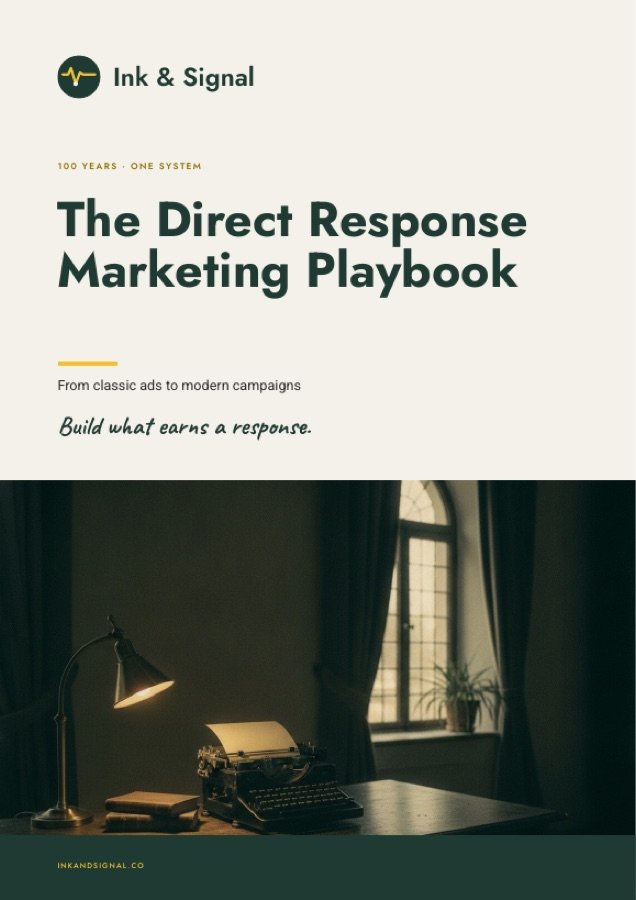
In the playbook his page covers the core idea, what to borrow today and the limit to respect. His line is research before decoration.
the playbook
Get the playbook today.
One PDF, yours to keep. Read it on any screen or print the pages you want on the wall.
30-DAY
MONEY
BACK
$37
- The 48-page playbook (A4 PDF)
- 8 masters, 10 systems, 100 principles
- 30 worked example ads, with notes
- The 30-day build and stage tracker
- Bonuses worth $123: ReplaStats, a Blind Spot Audit and more
30-day money-back guarantee. If the book is not for you, write to hello@inkandsignal.co within 30 days and we refund you in full, and you keep the PDF.
before you go
Common questions
Who was David Ogilvy?
A British-born advertising man who founded the agency that became Ogilvy & Mather in 1948. He was born in 1911 and died in 1999, and he wrote Confessions of an Advertising Man and Ogilvy on Advertising.
What is David Ogilvy known for?
Campaigns such as Rolls-Royce and the Hathaway shirt with the eye patch, and for books that treat advertising as research followed by a clear promise.
Was Ogilvy a direct response copywriter?
He worked in both brand advertising and direct response. He later said direct marketing was his first love and his secret weapon, and he held that ads should be judged by results.
What did Ogilvy say about headlines?
He wrote that on average five times as many people read the headline as read the body copy, so he gave headlines the most time. The figure is his, from his own agency’s work, so test it in your market.
Which Ogilvy book should I read first?
Ogilvy on Advertising is the practical one, organized by subject. Confessions of an Advertising Man is the earlier book, with his rules and stories from running an agency.
Where does Ogilvy fit in Ink & Signal?
He is one of the eight masters, with the line research before decoration.
keep reading
Related
Ogilvy on Advertising
The book, what it covers and who should read it.
Scientific advertising
Claude Hopkins on testing every claim.
Headline examples
Ten types of headline, each with a rewrite.